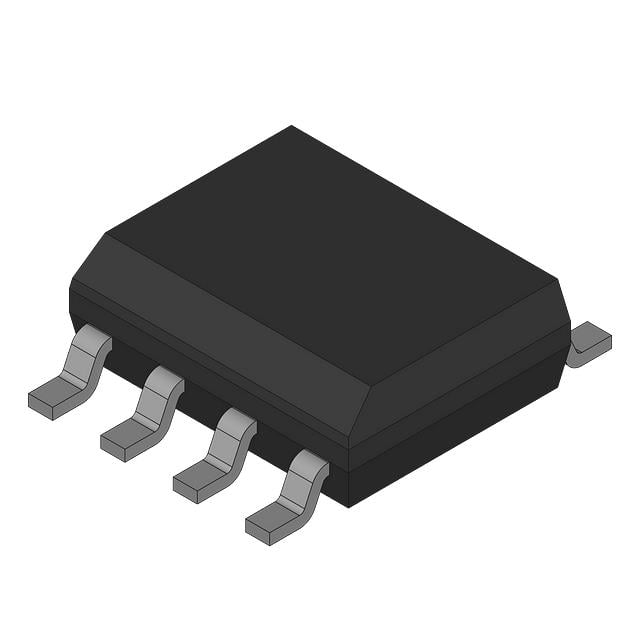
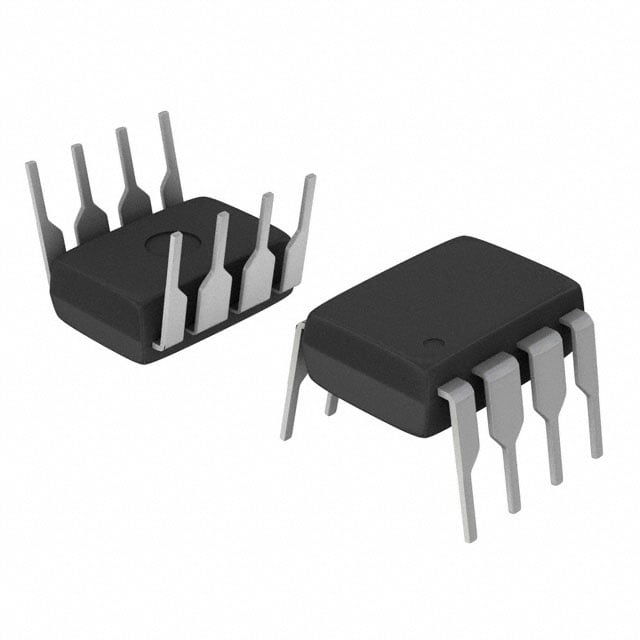
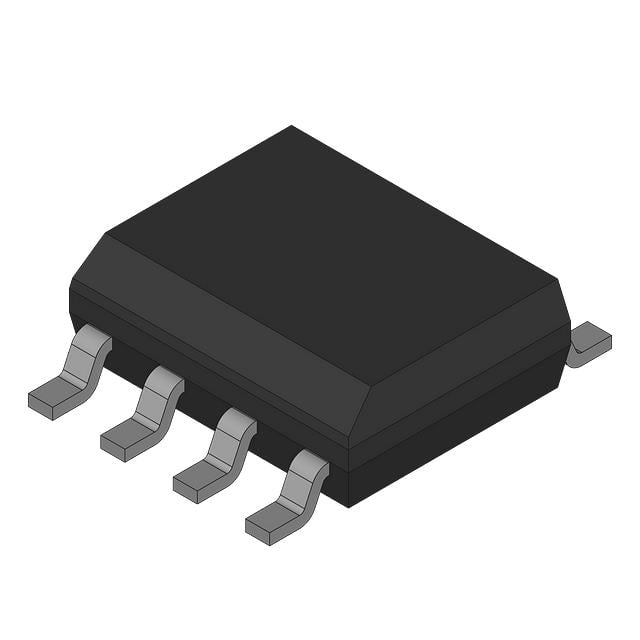
The Fairchild Semiconductor ACE1101N is a high-performance analog switch specifically designed for low-voltage, high-speed signal switching applications. Functionally, it belongs to the class of single-pole single-throw (SPST) CMOS analog switches, providing bidirectional signal conduction with very low on-resistance and minimal signal distortion. The device integrates complementary MOSFETs to achieve low leakage currents and ensures nearly linear on-state resistance across the full analog voltage range, making it suitable for precision analog signal routing in sensitive circuits. Its architecture is optimized for minimal charge injection and low capacitance, characteristics critical for maintaining signal integrity in high-frequency or low-voltage analog systems.
The ACE1101N operates with a single supply voltage range of 1.8 V to 5.5 V, accommodating contemporary low-voltage digital logic levels. Its maximum continuous current handling capability is specified at 200 mA, ensuring robust operation in moderate-load analog switching scenarios. The on-resistance (R_ON) is typified at approximately 3.5 ohms at V_CC = 5 V, with a noted variance across the supply voltage range and temperature spectrum; the datasheet indicates a maximum on-resistance of 5 ohms under worst-case conditions, guaranteeing predictable voltage drops in signal paths. Off-state leakage current is specified in the picoampere range at typical conditions, with a maximum of 1 nA at room temperature, supporting applications requiring high input impedance. The device exhibits low charge injection, typically 3 pC, ensuring minimal voltage transients during switching transitions. Its signal bandwidth is defined by a total off capacitance (C_OFF) of 10 pF and on capacitance (C_ON) of 25 pF, facilitating high-speed signal transmission up to several tens of megahertz without significant degradation. Switching times are rapid, with a typical turn-on delay of 50 ns and turn-off delay of 60 ns at a V_CC of 5 V, supporting responsive analog control in time-sensitive applications. The ACE1101N is available in a small SOT-23-5 surface-mount package, enabling compact PCB layouts and low parasitic contributions to sensitive analog circuitry.
From an application perspective, the ACE1101N is commonly employed in multiplexing and demultiplexing functions within analog front-end systems, where low on-resistance and minimal signal distortion are critical. It is suitable for audio and video signal routing, precision data acquisition systems, and low-voltage analog signal conditioning circuits. The bidirectional switching capability allows the device to serve as a configurable connection path in instrumentation systems, test equipment, and battery-powered portable devices. Its low voltage operation and minimal leakage currents make it advantageous in handheld measurement instruments and sensor interfaces where preserving signal integrity and minimizing power consumption are essential. Furthermore, the small package and low parasitic capacitance make it compatible with high-density analog matrix routing in communication and instrumentation systems.
The ACE1101N also finds utility in electronic switching of analog signals in digital control environments, where microcontrollers or FPGAs require precise routing of low-level analog signals with minimal latency and distortion. Its fast switching response supports multiplexed analog-to-digital conversion systems, where multiple channels must be sequentially presented to a single ADC input without introducing significant charge injection artifacts. The device's low R_ON variation with voltage and temperature ensures consistent analog performance across varying operating conditions, critical in precision measurement applications such as medical instrumentation, industrial process monitoring, and test automation. Additionally, its bidirectional capability allows flexible signal routing in differential analog systems and complex multipath analog networks, reducing the need for additional buffering or level-shifting circuitry.
Electrical characteristics of the ACE1101N include high common-mode voltage tolerance relative to supply rails, enabling safe switching in mixed-signal environments where analog signals may span the full supply range. It supports rail-to-rail signal handling without inducing significant distortion or nonlinearity. The device is designed for low power dissipation, with typical quiescent current on the order of 1 µA at 5 V supply, making it suitable for battery-operated or energy-sensitive applications. The on-resistance temperature coefficient is low, minimizing signal variation across the specified -40 °C to 85 °C operating temperature range. The ACE1101N exhibits stable performance over time and environmental conditions, ensuring reliability in both consumer and industrial-grade electronics. Electrostatic discharge (ESD) protection is integrated into the device, with HBM ratings typically around 2 kV, providing resilience against common handling and assembly conditions in manufacturing environments.
In terms of layout and integration considerations, the small SOT-23-5 footprint allows placement in high-density PCBs, and the symmetric pinout simplifies routing of analog signals. Power supply decoupling is recommended to minimize noise coupling into sensitive analog paths, and attention to ground plane design ensures optimal high-frequency performance. The low on-capacitance and off-capacitance values minimize crosstalk in multi-channel systems, supporting high-fidelity analog signal transmission. The ACE1101N is fully CMOS-compatible, enabling direct interfacing with modern low-voltage digital logic levels without additional level-shifting circuitry, which simplifies design and reduces board area.
Overall, the Fairchild Semiconductor ACE1101N represents a high-performance, low-voltage CMOS analog switch optimized for precision signal routing, low distortion, and high-speed operation. Its combination of low on-resistance, low leakage, fast switching times, and bidirectional capability makes it particularly suitable for analog multiplexing, audio and video signal routing, data acquisition systems, and portable instrumentation applications. The device’s electrical characteristics, small footprint, and CMOS-compatible logic interface support robust integration in compact, high-performance electronic systems where analog signal integrity and energy efficiency are critical. Its specifications and performance metrics make it a reliable component for both industrial and consumer electronics requiring precise and responsive analog signal switching.