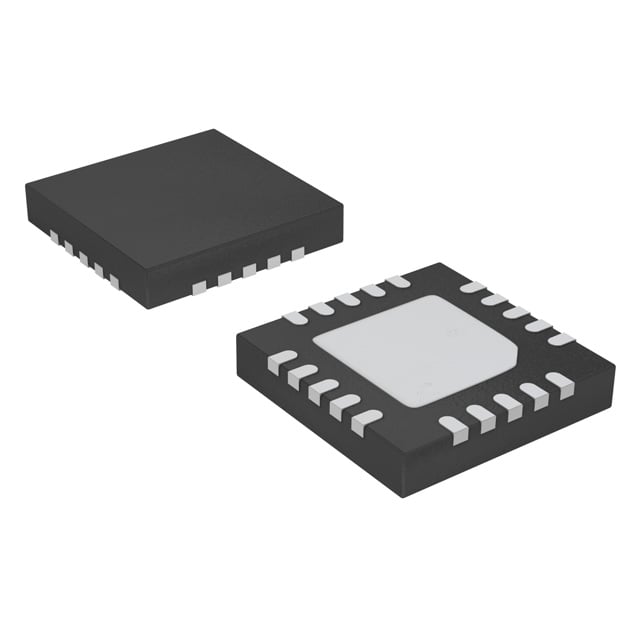
The Texas Instruments TPS630701RNMR is a high-efficiency, wide-input-voltage buck-boost converter designed to provide a fixed 5-V output for applications requiring a stable power supply across a broad input voltage range. Part of TI’s buck-boost converter family, it is optimized for battery-powered and portable devices, offering compact size, high efficiency, and robust performance. The device uses a single inductor and operates with a fixed-frequency PWM control scheme, making it suitable for space-constrained applications like IoT devices, portables, and industrial systems. Below is a detailed overview of the TPS630701RNMR, covering its functionality, specifications, applications, and design considerations.
Overview and Functionality
The TPS630701RNMR is a synchronous buck-boost DC-DC converter that delivers a fixed 5-V output from input voltages ranging from 2 V to 16 V, making it ideal for systems powered by single-cell Li-ion batteries, multi-cell alkaline batteries, or other variable voltage sources. It employs a four-switch buck-boost topology to seamlessly transition between buck, boost, and buck-boost modes, ensuring a stable output regardless of whether the input voltage is above, below, or equal to the output. The device features a fixed 2.4-MHz switching frequency, which allows the use of small external components, and includes power-save mode (PSM) for improved efficiency at light loads. Integrated protection features, such as overcurrent protection, thermal shutdown, and power-good signaling, enhance reliability in demanding applications.
Key Features
The TPS630701RNMR is equipped with a comprehensive set of features for efficient power management:
- Fixed 5-V Output: Provides a precise 5-V output with ±2% accuracy, ideal for USB-powered devices and 5-V rails.
- Wide Input Voltage Range: Operates from 2 V to 16 V, supporting diverse power sources like Li-ion batteries or 12-V adapters.
- High Efficiency: Achieves up to 95% efficiency in buck or boost mode, with power-save mode for light-load efficiency.
- Synchronous Rectification: Uses four integrated MOSFETs for high efficiency and reduced external component count.
- Fixed Switching Frequency: Operates at 2.4 MHz, enabling small inductors and capacitors.
- Power-Save Mode (PSM): Automatically enters PSM at light loads to improve efficiency, with seamless transition to PWM at higher loads.
- Protection Features: Includes overcurrent protection (OCP), thermal shutdown (150°C typical), overvoltage protection (OVP), and undervoltage lockout (UVLO).
- Power-Good Output: Signals when the output voltage is within regulation, aiding system diagnostics.
- Compact Package: Housed in a 15-pin VQFN-HR (2.5 mm x 3 mm) package for space-constrained designs.
- Low Quiescent Current: 50 µA typical in PSM, with 8 µA in shutdown mode.
Detailed Specifications
The TPS630701RNMR is characterized by precise electrical and operational parameters:
- Input Voltage Range: 2 V to 16 V, supporting single-cell Li-ion (2.7 V to 4.2 V), multi-cell alkaline, or 12-V inputs.
- Output Voltage: Fixed at 5 V with ±2% accuracy over the operating temperature range.
- Output Current: Up to 2 A continuous in buck mode; 1 A in boost mode at low input voltages (e.g., 2.5 V).
- Switching Frequency: Fixed at 2.4 MHz (typical), with ±10% variation.
- Efficiency: Up to 95% at 12-V input, 5-V output, and 1-A load; 80%–90% in PSM at light loads.
- Switch Current Limit: 3.6 A typical for the internal MOSFETs.
- MOSFET RDS(on): High-side: 100 mΩ typical; low-side: 80 mΩ typical (buck mode).
- Quiescent Current: 50 µA typical in PSM; 8 µA in shutdown mode.
- Line Regulation: ±0.5% typical over the input voltage range.
- Load Regulation: ±0.5% typical from 0 to 2 A.
- Operating Temperature Range: -40°C to +125°C, suitable for industrial and automotive-grade applications.
- Storage Temperature Range: -65°C to +150°C.
- Package: 15-pin VQFN-HR (2.5 mm x 3 mm), with exposed thermal pad for heat dissipation.
- Power Dissipation: Approximately 1.5 W maximum, depending on operating conditions.
- Fault Protection: Overcurrent protection (cycle-by-cycle limiting), thermal shutdown (150°C), OVP, and UVLO (1.8 V typical threshold).
- ESD Rating: Human Body Model (HBM) ±2 kV; Charged Device Model (CDM) ±500 V.
- Packaging: Available in Tape & Reel (TR) with 3000 units per reel, using Nickel/Palladium/Gold (Ni/Pd/Au) plating.
Applications
The TPS630701RNMR is designed for applications requiring a stable 5-V output from variable input voltages. Its primary applications include:
- Portable Devices: Powers USB interfaces, sensors, or microcontrollers in smartphones, tablets, and wearables.
- IoT Devices: Provides reliable 5-V rails for Wi-Fi modules, sensors, and low-power MCUs in battery-powered IoT systems.
- Industrial Systems: Supports 5-V rails in PLCs, HMIs, and sensor networks with 12-V or battery inputs.
- Battery-Powered Equipment: Ideal for single-cell Li-ion or multi-cell alkaline battery systems in medical devices or handheld tools.
- USB Power Supplies: Delivers 5-V output for USB charging or powered peripherals.
The wide input range and compact size make it versatile for both consumer and industrial applications where space and efficiency are critical.
Operational Mechanism
The TPS630701RNMR uses a four-switch buck-boost topology with two high-side and two low-side MOSFETs, enabling seamless transitions between buck, boost, and buck-boost modes. In buck mode (Vin > Vout), it steps down the input voltage; in boost mode (Vin < Vout), it steps up; and in buck-boost mode (Vin ≈ Vout), it maintains regulation. The fixed 2.4-MHz PWM control ensures constant switching frequency, reducing EMI and allowing small external components. At light loads, the power-save mode reduces switching frequency to minimize losses, with automatic transitions to PWM mode under heavier loads. The power-good output signals when the 5-V output is within ±5% of regulation, and protection features like cycle-by-cycle current limiting and thermal shutdown ensure reliability during faults.
Design Considerations
When designing with the TPS630701RNMR, engineers should consider the following:
- Inductor Selection: Choose a 1.0 µH to 2.2 µH inductor with a saturation current exceeding 3.6 A to handle peak currents. Low DCR (e.g., <50 mΩ) improves efficiency.
- Capacitor Selection: Use low-ESR ceramic capacitors: 10 µF to 22 µF for input and 22 µF to 47 µF for output to minimize ripple and ensure stability.
- Thermal Management: The VQFN-HR package’s exposed thermal pad must connect to a PCB ground plane for heat dissipation, especially at 2-A loads or high input voltages.
- Layout Guidelines: Minimize high-current loop areas (input capacitor, inductor, output capacitor) to reduce EMI. Place the feedback and power-good pins away from noisy nodes.
- Power-Save Mode: PSM is enabled by default but can be disabled for applications requiring low ripple at light loads.
- Evaluation Module: The TPS63070EVM-693 evaluation board is recommended for prototyping, allowing performance validation under various input and load conditions.
- Input Voltage Transients: Ensure the input source can handle transient currents, especially in boost mode at low input voltages.
Comparison with Similar Devices
The TPS630701RNMR is part of TI’s TPS63070 family, with the TPS63070RNMR offering an adjustable output (1.2 V to 12 V) instead of a fixed 5 V. Compared to the TPS630701RNMR, the adjustable version provides more flexibility but requires external resistors for voltage setting. Other TI devices, like the TPS63050 (smaller package, lower current), or competitors like Analog Devices’ ADP2504 (2.3 V to 15 V input, 1 A) or Maxim’s MAX8969 (2.5 A, 2.5 MHz), offer similar buck-boost functionality but differ in current capacity, efficiency, or package size. The TPS630701RNMR’s fixed 5-V output and high efficiency make it ideal for USB or 5-V rail applications, but engineers should compare datasheets for specific requirements.
Advantages and Limitations
Advantages:
- Wide Input Range: Supports 2 V to 16 V, accommodating diverse power sources like batteries or adapters.
- High Efficiency: Up to 95% efficiency with PSM for light loads, extending battery life in portable devices.
- Compact Design: The 15-pin VQFN-HR package and 2.4-MHz frequency enable small external components.
- Robust Protection: Overcurrent, thermal shutdown, OVP, and UVLO ensure reliable operation.
- Fixed Output: Simplifies design for 5-V applications without external feedback components.
Limitations:
- Fixed Output Voltage: Limited to 5 V, reducing flexibility compared to adjustable-output devices like the TPS63070RNMR.
- Output Current Limit: 2 A in buck mode and 1 A in boost mode may be insufficient for high-current applications.
- High Switching Frequency: The 2.4-MHz frequency increases switching losses at high input voltages compared to lower-frequency devices.
- Thermal Constraints: High-current operation at elevated temperatures requires careful PCB thermal design.
Practical Implementation
In a typical application, the TPS630701RNMR is configured with a 3.6-V Li-ion battery or 12-V adapter input, delivering a 5-V, 2-A output. A 1.5-µH inductor, 22-µF input capacitor, and 47-µF output capacitor are used to ensure low ripple and stability. The enable pin (EN) allows power sequencing, and the power-good (PG) output connects to a microcontroller for monitoring. The device automatically switches between buck, boost, and buck-boost modes based on the input voltage, with PSM reducing power consumption at light loads. The TPS63070EVM-693 evaluation module provides a pre-configured platform to test performance, allowing adjustments for specific input voltages or load transients. A well-designed PCB layout with short high-current paths and a large ground plane for the thermal pad is critical for optimal performance and thermal management.
Conclusion
The Texas Instruments TPS630701RNMR is a highly efficient, compact buck-boost converter tailored for 5-V applications in portable, IoT, and industrial systems. Its wide 2-V to 16-V input range, fixed 5-V output, and up to 95% efficiency make it ideal for battery-powered devices and USB power supplies. The 2.4-MHz switching frequency and VQFN-HR package enable small footprints, while features like PSM, power-good signaling, and robust protection ensure reliable operation. Although limited by its fixed output and 2-A current capacity, the TPS630701RNMR simplifies design for 5-V rails with minimal external components. The TPS63070EVM-693 evaluation module facilitates prototyping, helping engineers optimize designs for specific power requirements. Proper inductor selection, thermal management, and PCB layout are essential to maximize performance in demanding applications.