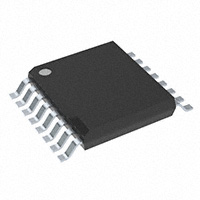
Q1: What is the Texas Instruments TL494IDR?
A1: The Texas Instruments TL494IDR is a high-performance pulse-width modulation (PWM) control IC, primarily used for power management and regulation in DC-DC converters, inverters, and motor control systems.
Q2: What is the main function of the TL494IDR?
A2: The TL494IDR functions as a PWM controller, providing efficient switching regulation for power conversion circuits. It is often used to drive power MOSFETs in various power supplies and converters.
Q3: What are the key features of the TL494IDR?
A3: Key features of the TL494IDR include high precision PWM control, adjustable frequency, dead-time control, error amplifier for feedback regulation, and a wide operating voltage range.
Q4: What is the input voltage range for the TL494IDR?
A4: The TL494IDR operates with an input voltage range of 4.5V to 40V, making it suitable for a wide variety of power supply applications.
Q5: What is the operating frequency range of the TL494IDR?
A5: The TL494IDR offers an adjustable oscillator frequency that can range from 10 kHz to 300 kHz, depending on the application requirements.
Q6: Can the TL494IDR be used in buck converters?
A6: Yes, the TL494IDR can be used in buck converters, as it is designed to efficiently control the duty cycle and manage voltage regulation for step-down power conversion.
Q7: Does the TL494IDR have a built-in error amplifier?
A7: Yes, the TL494IDR includes an internal error amplifier that helps regulate the output voltage by comparing it with the reference voltage, providing stable operation in feedback loops.
Q8: What is the output configuration of the TL494IDR?
A8: The TL494IDR provides two output transistors that can drive external power devices such as MOSFETs or bipolar junction transistors (BJTs) for high-power switching applications.
Q9: How is the TL494IDR protected from overvoltage and thermal damage?
A9: The TL494IDR is equipped with built-in protection features, including overvoltage protection and thermal shutdown, to prevent damage under extreme conditions.
Q10: Can the TL494IDR be used for both positive and negative feedback?
A10: Yes, the TL494IDR supports both positive and negative feedback configurations, making it versatile for a wide range of control applications.
Q11: What is the package type for the TL494IDR?
A11: The TL494IDR is available in an SOIC-16 package, which is compact and suitable for surface-mount applications.
Q12: Does the TL494IDR have any built-in voltage reference?
A12: Yes, the TL494IDR includes an internal 5V voltage reference, which simplifies the design process for voltage regulation circuits.
Q13: Is the TL494IDR suitable for motor control applications?
A13: Yes, the TL494IDR is suitable for motor control applications, as it can generate PWM signals to control the speed and torque of motors.
Q14: How does the TL494IDR adjust the duty cycle?
A14: The duty cycle of the TL494IDR is adjusted by varying the external timing components (resistors and capacitors) that set the frequency and pulse width of the PWM output.
Q15: Can the TL494IDR be used in boost converters?
A15: Yes, the TL494IDR is commonly used in boost converters, providing the necessary PWM control for stepping up the input voltage.
Q16: What is the maximum output current for the TL494IDR?
A16: The TL494IDR can source and sink up to 200 mA of output current, which is typically sufficient to drive external MOSFETs or BJTs in power converter circuits.
Q17: Does the TL494IDR support soft start functionality?
A17: Yes, the TL494IDR supports soft start functionality, which allows gradual ramp-up of the output voltage, reducing inrush current and minimizing stress on components.
Q18: What are the typical applications for the TL494IDR?
A18: The TL494IDR is commonly used in power supplies, DC-DC converters, inverters, motor control systems, and other applications that require efficient PWM control and voltage regulation.
Q19: Is the TL494IDR suitable for low-power applications?
A19: While the TL494IDR is designed for a wide range of power applications, it is more commonly used in medium to high-power systems where efficient PWM control is necessary.
Q20: What are the main benefits of using the TL494IDR?
A20: The main benefits of using the TL494IDR include its high efficiency, adjustable frequency, reliable feedback regulation, and versatility in controlling various power conversion applications.