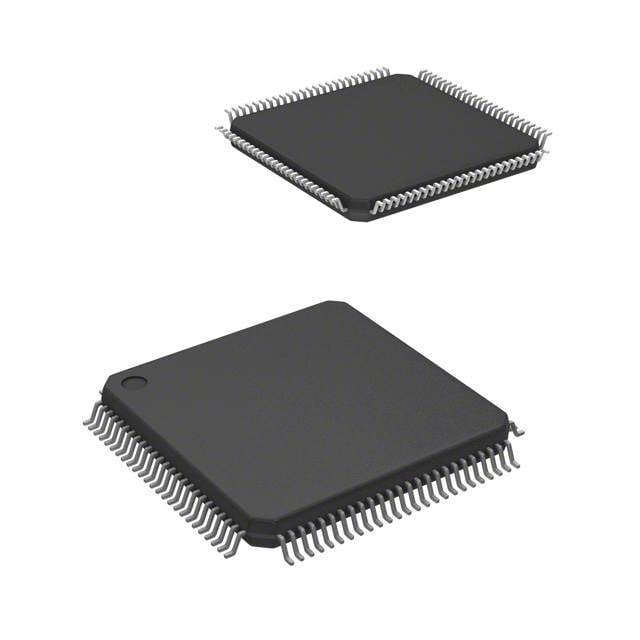
The STM32F103VET6 is part of STMicroelectronics' STM32F1 series, a family of 32-bit microcontrollers based on the ARM Cortex-M3 core. The STM32F103VET6 is designed for applications requiring a balance of performance, power efficiency, and ease of integration. Its versatile peripheral set, low power consumption, and robust processing capabilities make it suitable for a broad range of embedded applications such as industrial control, automotive, consumer electronics, and communication systems.
## Overview
The STM32F103VET6 is a 32-bit microcontroller that integrates the ARM Cortex-M3 core, providing an efficient and powerful architecture for embedded applications. Operating at a maximum clock frequency of 72 MHz, it is capable of handling complex tasks, including real-time control, signal processing, and communication management. The microcontroller offers 512 KB of flash memory for program storage and 64 KB of SRAM for fast data access and buffering. With a wide range of communication interfaces and peripherals, the STM32F103VET6 is designed for systems that need to interface with external devices while offering a reliable and cost-effective solution.
## Key Features
1. ARM Cortex-M3 Core:
* The STM32F103VET6 is powered by the ARM Cortex-M3 processor, which is optimized for embedded systems. The Cortex-M3 architecture provides a balance between performance and power efficiency, supporting high-speed processing with low energy consumption. It offers a 32-bit RISC architecture that allows efficient execution of software.
* The processor operates at a maximum frequency of 72 MHz, allowing the STM32F103VET6 to handle time-sensitive applications in real time.
2. Memory:
* Flash Memory: The microcontroller features 512 KB of flash memory, providing ample space for storing programs and firmware. Flash memory is non-volatile, which means it retains data even when power is lost, making it suitable for embedded systems where the firmware must be preserved.
* SRAM: The STM32F103VET6 includes 64 KB of SRAM. SRAM is fast memory that is used to store variables, buffers, and temporary data during the operation of the microcontroller. The larger SRAM size allows for efficient handling of real-time data, enabling smoother operation in systems requiring high data throughput.
3. Peripherals:
* The STM32F103VET6 provides a rich set of peripherals, allowing the microcontroller to interact with a wide range of external devices. These peripherals are essential for real-time control, sensor interfacing, and communication with other systems.
* General-purpose timers: The STM32F103VET6 includes several general-purpose timers that can be used for time measurement, pulse-width modulation (PWM) signal generation, and event timing. These timers are important for tasks such as motor control, signal generation, and event triggering.
* Analog-to-Digital Converters (ADC): The microcontroller features 3x 12-bit ADCs, providing accurate analog-to-digital conversion. These ADCs support up to 1 Msps (million samples per second) and up to 16 input channels, making the STM32F103VET6 suitable for sensor interfacing and real-time data acquisition applications.
* Digital-to-Analog Converters (DAC): The STM32F103VET6 includes 2x 12-bit DACs for generating analog output signals. These DACs are useful for applications such as signal synthesis, audio generation, and control systems that require precise analog outputs.
4. Communication Interfaces:
* USART (Universal Synchronous Asynchronous Receiver Transmitter): The microcontroller supports 2x USART interfaces, enabling serial communication with external devices such as sensors, displays, and other microcontrollers. USART is widely used for UART-based communication, supporting both asynchronous and synchronous modes.
* SPI (Serial Peripheral Interface): The STM32F103VET6 supports 2x SPI interfaces, which allow for high-speed communication with external peripherals such as memory devices, sensors, and displays. SPI is a synchronous protocol, offering faster data transfer rates than traditional UART.
* I2C (Inter-Integrated Circuit): The microcontroller features 2x I2C interfaces, which allow communication with I2C-compatible devices such as EEPROMs, sensors, and other peripherals. I2C is a widely used communication protocol in embedded systems, particularly for low-speed devices.
* CAN (Controller Area Network): The CAN interface is included for communication in automotive, industrial, and real-time systems. CAN is known for its robustness and reliability in environments where communication integrity is critical, such as in multi-node networks.
* USB 2.0: The STM32F103VET6 includes USB 2.0 full-speed support for communication with external USB devices, such as USB flash drives, communication modules, and peripherals. This is useful in systems that require data exchange between the microcontroller and USB devices.
5. DMA (Direct Memory Access):
* The microcontroller is equipped with a 12-channel DMA controller, which allows for high-speed data transfers between memory and peripherals without CPU intervention. This significantly reduces the load on the processor, allowing it to focus on other tasks while data is being transferred between peripherals and memory.
6. Low Power Consumption:
* The STM32F103VET6 is designed with several low-power modes to optimize energy consumption. These include Sleep, Stop, and Standby modes, which are useful in battery-powered applications or systems that need to conserve energy during periods of inactivity.
7. Watchdog Timer:
* The microcontroller includes an independent watchdog timer, which resets the system if a software fault or error is detected. This ensures that the system can recover from unexpected states and maintain reliable operation, which is critical for embedded systems in industrial or safety-critical applications.
8. Development Support:
* The STM32F103VET6 supports JTAG and SWD (Serial Wire Debug) interfaces, which are essential for debugging and programming the microcontroller. These interfaces enable real-time monitoring, step-through debugging, and efficient development workflows.
9. Security Features:
* The microcontroller includes read-out protection, which prevents unauthorized access to the program memory. This feature is essential for applications where data security and firmware protection are important.
## Specifications
Here are the detailed specifications of the STM32F103VET6:
* Core: ARM Cortex-M3, 32-bit RISC processor
* Clock Speed: Up to 72 MHz
* Flash Memory: 512 KB
* SRAM: 64 KB
* Operating Voltage: 2.0V to 3.6V
* I/O Pins: Up to 100 I/O pins
* Timers:
* 3x general-purpose timers
* 1x advanced-control timer
* PWM outputs
* ADC:
* 3x 12-bit ADCs
* Up to 1 Msps sampling rate
* Up to 16 input channels
* DAC:
* 2x 12-bit DACs
* Communication Interfaces:
* 2x USART
* 2x SPI
* 2x I2C
* 1x CAN
* 1x USB 2.0 Full-speed
* DMA Controller: 12-channel DMA controller
* Low Power Modes: Sleep, Stop, and Standby modes
* Watchdog Timer: Independent and window watchdog timers
* Package: LQFP-100 (100 pins)
* Temperature Range: -40°C to 85°C (standard)
* Operating Temperature Range: -40°C to 85°C
## Applications
The STM32F103VET6 is a versatile microcontroller that can be used in a wide variety of applications. Some common use cases include:
1. Industrial Control Systems:
* The STM32F103VET6 is ideal for industrial automation, sensor networks, and real-time control applications. Its powerful core, multiple I/O interfaces, and precise analog-to-digital conversion make it suitable for managing complex industrial processes.
2. Consumer Electronics:
* This microcontroller can be used in a range of consumer electronics applications, such as smart home devices, audio systems, and wearable technology, where reliability, power efficiency, and cost-effectiveness are important.
3. Automotive:
* The CAN interface makes the STM32F103VET6 suitable for automotive applications, including vehicle control systems, sensor interfacing, and in-vehicle networking.
4. Communication Systems:
* The STM32F103VET6 is ideal for communication systems that require serial communication, data exchange, and real-time processing. Its USART, SPI, and I2C interfaces make it flexible for various types of communication protocols.
5. Embedded Systems:
* The microcontroller’s rich set of peripherals and low power consumption make it suitable for a wide range of embedded systems, including data acquisition systems, measurement instruments, and control applications.
6. Audio and Signal Processing:
* The STM32F103VET6 is well-suited for audio applications and signal processing tasks. The inclusion of DACs and ADCs allows it to handle analog signals, making it useful for real-time audio generation and processing.
## Conclusion
The STM32F103VET6 is a versatile and powerful microcontroller that offers a solid balance of performance, memory, and peripheral options. With 512 KB of flash memory, 64 KB of SRAM, and a wide variety of communication interfaces, it can be used in a broad range of embedded systems. Whether you are designing industrial control systems, consumer electronics, or automotive applications, the STM32F103VET6 offers a reliable and cost-effective solution for your needs. Its ARM Cortex-M3 core ensures efficient processing, while its comprehensive set of peripherals makes it an excellent choice for complex embedded applications.