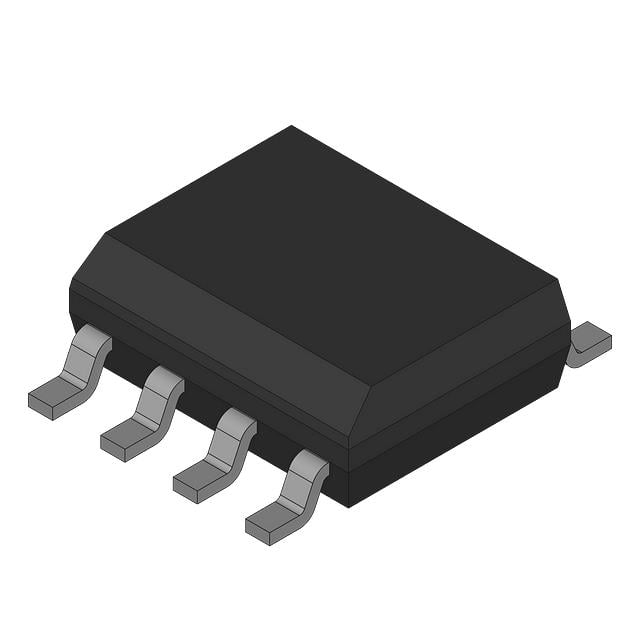
Overview of Texas Instruments OPA316IDBVR
The Texas Instruments OPA316IDBVR is a precision operational amplifier optimized for low noise, low offset voltage, and low power consumption. It belongs to the OPA316 series known for stable operation over a wide range of supply voltages and exceptional DC and AC performance. This device is ideal for applications that require high accuracy and low noise in small-signal amplification, including sensor interfaces, data acquisition systems, and precision instrumentation.
Functional Description
The OPA316IDBVR is a single-supply or dual-supply operational amplifier featuring low input offset voltage and ultra-low input bias current. Its CMOS architecture enables rail-to-rail input and output voltage swing, maximizing dynamic range in low-voltage applications. The amplifier maintains high gain accuracy and low distortion across its operating range, making it suitable for precision amplification.
The device is unity-gain stable and requires no external frequency compensation, simplifying circuit design. Its low quiescent current supports battery-powered and low-power applications while delivering excellent noise performance and offset stability.
Key Features
* Low input offset voltage: typically 150 µV maximum
* Ultra-low input bias current: typically 10 pA
* Rail-to-rail input and output voltage swing
* Low input voltage noise density: 9 nV/√Hz at 1 kHz
* Unity-gain stable with no external compensation
* Low quiescent current: 900 µA typical
* Wide supply voltage range: 2.7 V to 12 V
* Gain bandwidth product: 1.3 MHz typical
* Slew rate: 0.5 V/µs typical
* Input common-mode voltage range includes ground
* Low total harmonic distortion and noise
* Input and output voltage range includes negative rail (ground)
* Small SOT-23 package for compact designs
* Operating temperature range: –40°C to +125°C
Electrical Specifications
* Supply Voltage Range (V\_S): 2.7 V to 12 V (single or dual supply)
* Input Offset Voltage (V\_OS): ±150 µV max
* Input Bias Current (I\_B): Typically 10 pA
* Input Voltage Noise Density: 9 nV/√Hz at 1 kHz
* Gain Bandwidth Product (GBW): 1.3 MHz typical
* Slew Rate: 0.5 V/µs typical
* Input Common Mode Voltage Range: Rail-to-rail including ground
* Output Voltage Swing: Rail-to-rail within millivolts under typical load
* Quiescent Current: 900 µA typical at 5 V supply
* Total Harmonic Distortion (THD): Less than 0.0001% at 1 kHz
* Operating Temperature Range: –40°C to +125°C
Pin Configuration and Package
The OPA316IDBVR is supplied in a compact 5-pin SOT-23 package designed for surface mounting. This small footprint package is suitable for space-constrained PCB layouts common in portable and embedded designs. The pin assignments include:
* Non-inverting input
* Inverting input
* Output
* Positive supply voltage (V+)
* Ground or negative supply voltage (V–)
The small package promotes reduced parasitic capacitance and inductance, enhancing signal integrity in high-precision analog circuits.
Applications
* Precision sensor signal conditioning (temperature, strain gauges, photodiodes)
* Portable and battery-powered instrumentation
* Data acquisition systems requiring low noise and high accuracy
* Low-level signal amplification in medical devices
* Low noise preamplifiers for audio and instrumentation
* Current sensing and transducer interfaces
* High-resolution analog front-ends
Performance and Design Considerations
The OPA316IDBVR’s combination of low input offset voltage and ultra-low input bias current reduces errors in amplifying very small signals, enhancing measurement accuracy. The rail-to-rail input/output capability allows maximizing signal dynamic range even in low-voltage single-supply environments.
Its moderate gain bandwidth product and slew rate make it ideal for low-to-medium frequency applications where noise and DC precision are critical but ultra-high-speed response is not necessary.
Due to its CMOS architecture, the device exhibits low input bias current, which minimizes input offset drift caused by input current variations, especially important when amplifying signals from high-impedance sources.
For stable operation, care should be taken with PCB layout, minimizing noise coupling and using proper power supply decoupling close to the device.
Thermal and Reliability Considerations
The small SOT-23 package allows for good thermal performance in typical low-power applications. The device can operate safely over a wide temperature range, making it suitable for industrial and commercial environments. However, thermal management considerations may arise when operating near the upper limits of supply voltage and power dissipation in confined spaces.
Summary
The Texas Instruments OPA316IDBVR is a precision, low-noise, low-power operational amplifier that offers excellent DC accuracy, rail-to-rail input/output capability, and ultra-low input bias current in a small package. Its stable operation over a wide supply voltage range and low distortion characteristics make it well suited for sensitive analog signal amplification in portable, medical, industrial, and instrumentation applications. The device’s balance of low noise, precision, and low power consumption provides designers with a versatile component for high-accuracy, low-level signal processing tasks.