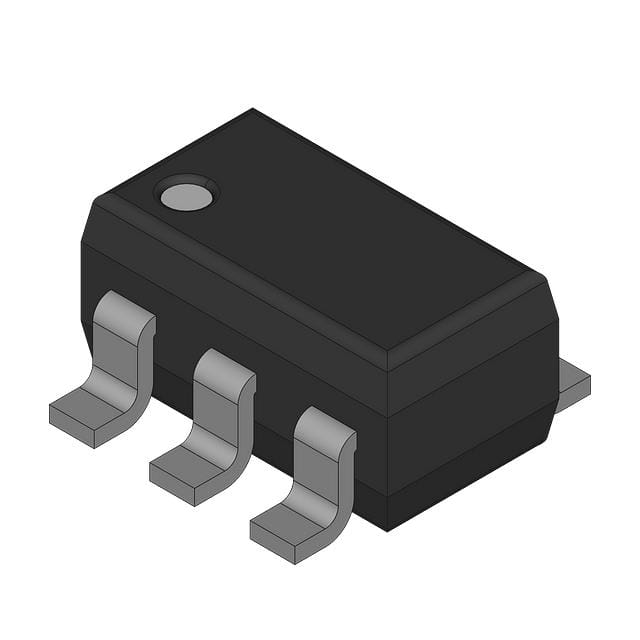
The Maxim Integrated MAX5419NETA is a precision, quad digital potentiometer designed to provide digitally programmable resistance for signal conditioning, calibration, and tuning applications in both analog and mixed-signal systems. The device features low temperature coefficient, high linearity, and nonvolatile EEPROM memory, enabling stable and repeatable adjustment of resistance values over time and across varying environmental conditions. Its compact 16-lead TSSOP package facilitates integration into high-density PCBs, making it ideal for instrumentation, industrial control, and communication systems.
## Functional Description
The MAX5419NETA integrates four independent digital potentiometer channels, each consisting of a resistor ladder with an 8-bit resolution and an SPI-compatible interface for digital control. Each potentiometer channel can function as a variable resistor (RAB), a variable voltage divider, or as part of programmable gain or offset circuits. The device operates with a single supply voltage and includes internal EEPROM to store wiper positions, ensuring that programmed settings are retained even when power is removed. The high-precision resistor ladder and low wiper resistance enable accurate voltage division and minimal signal distortion.
## Electrical Specifications
* Number of Potentiometer Channels: 4 independent channels, each programmable via SPI.
* Resistance Value (RAB): 10 kΩ nominal per channel, with ±20% tolerance across the device.
* Resolution: 8-bit, allowing 256 discrete steps per potentiometer channel.
* Wiper Resistance (Rw): Typically 50 Ω, ensuring minimal voltage drop when wiper current flows.
* Nonlinearity: ±1 LSB maximum, supporting precise analog adjustment.
* Temperature Coefficient: 50 ppm/°C typical, providing stable performance over industrial temperature ranges.
* Digital Interface: SPI-compatible with standard SCLK, MOSI, MISO, and CS pins for straightforward microcontroller integration.
* Supply Voltage (VDD): 2.7 V to 5.5 V, accommodating both low-voltage and standard logic systems.
* Supply Current (IDD): 1 mA typical at 5 V, minimizing power consumption in battery-operated or low-power applications.
* Operating Temperature Range: -40°C to +85°C, suitable for industrial and automotive-grade applications.
## Input and Output Characteristics
* Digital Inputs: Compatible with standard CMOS logic levels, ensuring reliable communication with microcontrollers and DSPs. Inputs are Schmitt-triggered for noise immunity.
* Potentiometer Terminals: Each channel provides three terminals (A, B, and W), allowing flexible configurations as variable resistors or voltage dividers. The low wiper resistance ensures minimal signal loss and precise voltage scaling.
* EEPROM Memory: Wiper positions can be stored to nonvolatile memory and recalled on power-up, enabling repeatable calibration and configuration without external programming hardware.
## Switching and Timing Characteristics
* Maximum SPI Clock Frequency: 10 MHz, allowing fast wiper updates for real-time adjustments in dynamic analog circuits.
* Wiper Transition Time: Approximately 10 µs typical between adjacent steps, supporting smooth analog ramping for signal conditioning or filtering applications.
* Digital-to-Analog Accuracy: ±1 LSB typical, providing high fidelity in analog voltage adjustment across all wiper positions.
* Nonvolatile Write Cycles: Up to 1 million cycles, ensuring durable memory storage over the product lifetime.
## Thermal Performance
* Power Dissipation: Low power consumption due to CMOS design and single-supply operation. Power loss scales primarily with applied voltage and load on wiper terminals.
* Thermal Stability: Device maintains consistent resistance values across the full temperature range, with minimal drift due to the low temperature coefficient of the internal resistor ladder.
* Package Thermal Resistance: Approximately 110°C/W junction-to-ambient in a standard TSSOP PCB layout; adequate for low-power operation without additional heatsinking.
## Mechanical and Package Characteristics
The MAX5419NETA is provided in a 16-lead TSSOP package, enabling compact PCB design and high component density. The leads are compatible with automated surface-mount assembly processes. The package ensures mechanical robustness and reliable electrical connections, while maintaining a small footprint for integration in portable or space-constrained systems.
## Reliability and Protection Features
* EEPROM Retention: Minimum 100 years, guaranteeing that calibration and configuration settings are preserved over long-term operation.
* Electrostatic Discharge (ESD) Protection: All pins are rated to withstand human-body model ESD events up to ±2 kV, protecting the device during handling and assembly.
* Voltage Tolerance: Inputs are designed to tolerate overvoltage conditions within supply range limits, reducing susceptibility to transient events in industrial environments.
* Robust Switching: Internal CMOS architecture minimizes susceptibility to noise and ensures stable wiper transitions under dynamic electrical conditions.
## Applications
* Instrumentation: Programmable gain amplifiers, precision voltage dividers, and sensor calibration circuits.
* Industrial Control: Adjustable setpoints, reference scaling, and programmable resistive networks in control loops.
* Communication Systems: Signal leveling, analog tuning, and adaptive biasing in RF and baseband circuits.
* Consumer Electronics: User-adjustable controls, volume scaling, and analog signal shaping.
* Automotive: Calibration of sensors, actuators, and analog signal conditioning in harsh environments.
## Key Advantages
* Quad-channel configuration reduces component count and PCB complexity.
* Nonvolatile EEPROM allows stored wiper positions to be retained without continuous power.
* High-resolution 8-bit control provides fine-grained analog adjustment.
* Low wiper resistance and high linearity ensure minimal signal distortion.
* Wide supply voltage range supports modern low-voltage digital systems.
* Industrial temperature rating ensures reliable operation in harsh environments.
## Summary
The Maxim Integrated MAX5419NETA is a precision quad digital potentiometer offering nonvolatile memory, low wiper resistance, and high linearity for analog signal adjustment, calibration, and conditioning. Its combination of SPI interface control, robust temperature stability, and compact surface-mount package makes it ideal for instrumentation, industrial control, automotive systems, and consumer electronics where precise, repeatable resistance adjustment is required across a wide operating environment.