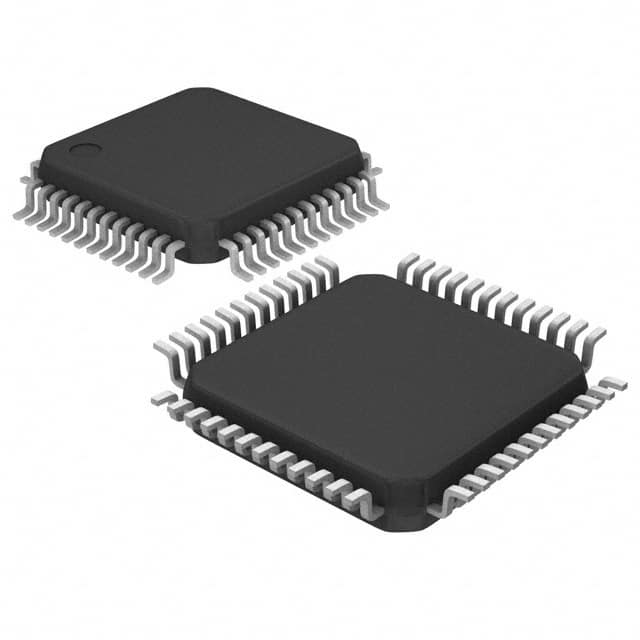
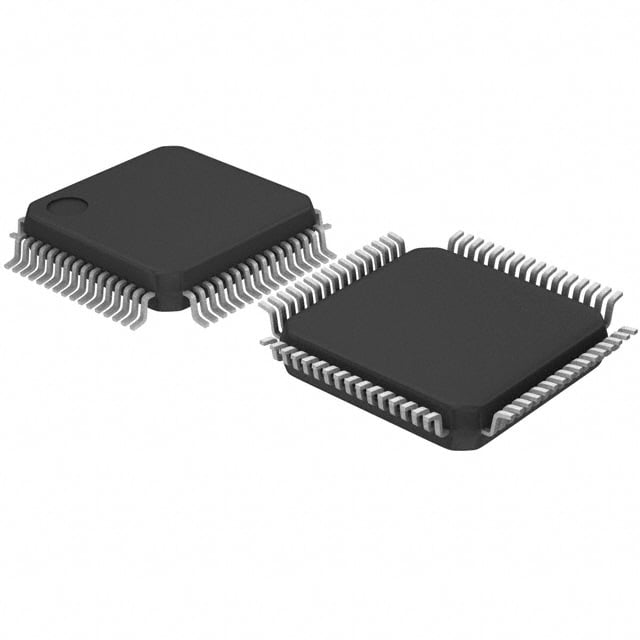
The Nuvoton Technology M032LE3AE is a 32-bit microcontroller based on the Arm® Cortex®-M0 core, offering a blend of high performance, low power consumption, and rich peripheral features tailored for a wide range of general-purpose and industrial control applications. This MCU is part of the M032 series, designed to provide a cost-effective yet capable platform for developers targeting consumer, industrial, and IoT segments.
Core and Performance
At the heart of the M032LE3AE is the Arm Cortex-M0 core operating at speeds up to 48 MHz. This core is highly efficient, with a 32-bit RISC architecture optimized for embedded control. The M0 core supports the Thumb instruction set, enabling compact code size and reduced memory usage. Its performance allows it to handle time-critical tasks and signal processing for applications requiring real-time response.
Memory
The M032LE3AE is equipped with 64 KB of embedded Flash memory and 8 KB of SRAM. The Flash memory is used for program storage and supports In-System Programming (ISP) and In-Application Programming (IAP), allowing for flexible firmware upgrades. The SRAM provides temporary data storage and stack/heap support. In addition, the chip features a 2 KB cache for optimized Flash access performance, reducing wait states during instruction fetches or data reads.
Power Efficiency
This microcontroller is designed for low power operation. It includes multiple power-down modes, such as Power-down, Idle, and Deep Power-down, which help reduce system power consumption when the CPU is not actively processing. A Power Voltage Detector (PVD) and Brown-out Detector (BOD) are also available to safeguard against unsafe voltage conditions. The operating voltage ranges from 1.8 V to 3.6 V, enabling flexible power supply configurations.
Clock System
The M032LE3AE includes a sophisticated clock control system. It features a built-in 48 MHz high-speed internal oscillator (HIRC), a 10 kHz low-speed internal oscillator (LIRC), and the capability to connect to an external crystal oscillator for more precise timing. The system allows dynamic clock scaling and supports Clock Output (CLKO) for system diagnostics.
Connectivity and Communication Interfaces
The M032LE3AE offers multiple serial communication peripherals to interface with a wide variety of external devices:
* UART: Up to 6 channels supporting full-duplex operation, RS-485 mode, and hardware flow control (RTS/CTS).
* SPI: Up to 2 channels supporting master/slave modes, programmable clock polarity and phase, and 8-/16-/32-bit transfer frames.
* I²C: Up to 2 channels supporting standard-mode (100 kHz), fast-mode (400 kHz), and fast-mode plus (1 MHz), with SMBus 2.0 support.
* CAN: A single CAN 2.0B controller for industrial networking applications.
* Smart Card Interface: Supports asynchronous communication and complies with ISO-7816-3 standard.
Timers and PWM
The M032LE3AE integrates an extensive array of timers and pulse width modulation channels:
* General Purpose Timers: 6 timers with 16-bit resolution, configurable as periodic, one-shot, or toggle output modes.
* PWM: Up to 12 channels of PWM with independent duty cycle and frequency control. The PWM module supports complementary mode and dead-time insertion for motor control and power supply applications.
Analog Features
This MCU includes a rich analog subsystem, suitable for sensor interfacing and signal measurement:
* 12-bit ADC: 16-channel analog-to-digital converter with up to 2 MSPS sampling rate. It supports single-ended and differential input modes, hardware trigger, and configurable sample averaging.
* Analog Comparator: 2 independent comparators that can be used for threshold detection or waveform shaping.
Security and Protection
For security-critical applications, the M032LE3AE incorporates several protection mechanisms:
* Flash Lock Bits: Prevent unauthorized read/write access to program memory.
* Cyclic Redundancy Check (CRC): Enables memory integrity verification for firmware and data.
* Watchdog Timers: Both Windowed Watchdog Timer (WWDT) and Independent Watchdog Timer (WDT) provide system recovery mechanisms in the event of software malfunctions.
GPIO and I/O Flexibility
The microcontroller offers 51 general-purpose I/O (GPIO) pins. Each pin is capable of digital input/output and is highly configurable, supporting pull-up, pull-down, open-drain, and Schmitt trigger modes. Many pins are multiplexed with peripheral functions and include glitch filters for signal integrity. The I/O supports up to 5V tolerance on selected pins, increasing compatibility with legacy hardware.
Package and Operating Conditions
The M032LE3AE is available in an LQFP64 package, making it suitable for both prototyping and volume production. It operates in the temperature range of -40°C to +105°C, which suits it for harsh industrial environments. Its compact footprint and high I/O count make it ideal for board space-constrained designs.
Development and Debug Support
Development is streamlined through support for industry-standard debug interfaces, including SWD (Serial Wire Debug). The device integrates an on-chip ICE (In-Circuit Emulator) and offers comprehensive support through Nuvoton’s Nu-Link debugger and NuEclipse IDE. The rich development ecosystem facilitates quick prototyping, debugging, and deployment.
Applications
The M032LE3AE is well-suited for applications such as industrial control, motor drives, smart meters, power management systems, home automation devices, and portable instrumentation. Its blend of connectivity, analog capability, and performance positions it as a versatile solution for embedded system developers.
Key Specifications Summary
* CPU: Arm Cortex-M0 @ 48 MHz
* Flash: 64 KB
* SRAM: 8 KB
* ADC: 12-bit, 16-channel, 2 MSPS
* UART: 6 channels
* SPI: 2 channels
* I²C: 2 channels
* CAN: 1 channel
* PWM: 12 channels
* Operating Voltage: 1.8 V to 3.6 V
* Operating Temperature: -40°C to +105°C
* GPIOs: 51
* Package: LQFP64
* Debug Interface: SWD
* Security: CRC, WDT, WWDT, Flash protection
The Nuvoton M032LE3AE stands out as a compact, efficient, and peripheral-rich MCU ideal for a broad range of embedded applications requiring reliable performance and extensive interfacing capability.