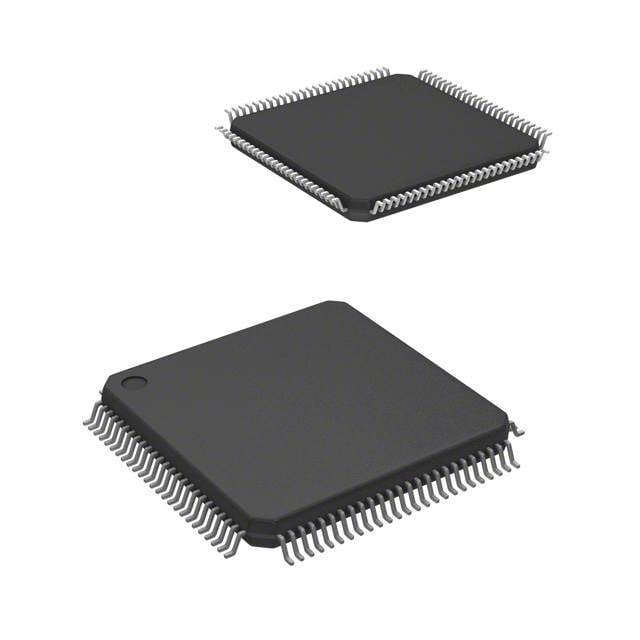
## Overview
The Lattice Semiconductor ICE5LP2K-CM36ITR50 is a low-power, high-performance FPGA from the iCE5LP family, designed for cost-sensitive and energy-efficient applications. It features a non-volatile flash-based architecture that enables instant-on operation, low static power, and robust logic performance in a small form factor. This device targets embedded control, interface bridging, industrial automation, consumer electronics, and portable systems where low power, deterministic timing, and compact integration are critical.
## Device Architecture
* Logic Elements: 2,000 logic elements (LEs), providing sufficient combinational and sequential resources for small- to medium-complexity designs.
* Configurable Logic Blocks (CLBs): Each CLB contains a combination of 4-input look-up tables (LUTs) and flip-flops, enabling arithmetic, control, and state machine logic.
* Carry Chains: Dedicated fast carry logic supports efficient implementation of adders, comparators, counters, and accumulation operations.
* Interconnect Fabric: Flash-based programmable routing provides low-skew, deterministic paths for signal propagation, enabling predictable timing across the device.
* Embedded Registers: Distributed flip-flops and registers facilitate pipeline stages, state storage, and temporary buffering within the design.
## I/O and Interfaces
* General-Purpose I/O: 36 pins supporting multiple voltage standards including LVCMOS, LVTTL, and LVDS for interfacing with diverse peripherals.
* I/O Features: Programmable drive strength, adjustable slew rate, open-drain configuration, and optional internal pull-ups or pull-downs to optimize signal integrity and drive performance.
* Peripheral Interface Support: Capable of SPI, I²C, UART, parallel buses, and user-defined signaling protocols, enabling flexible system integration.
* Pin Multiplexing: Flexible pin allocation supports optimized PCB layout and integration of multiple high-speed signals.
## Clocking and Timing
* Global Clock Networks: Multiple low-skew global clock lines distribute synchronous signals efficiently across the device.
* Maximum Core Frequency: Typical core logic operation up to 150–200 MHz depending on logic utilization, placement, and routing.
* PLLs: Integrated phase-locked loops allow clock multiplication, division, phase alignment, and jitter management for multi-domain synchronous designs.
* Deterministic Timing: Fixed routing and dedicated clock paths ensure predictable propagation delays, supporting timing-critical applications.
## Memory Architecture
* Embedded RAM: Small distributed RAM blocks for temporary storage, FIFO buffers, and lookup tables for control logic and pipeline registers.
* Access Features: Synchronous read/write operations with configurable width, optional pipelined access for higher throughput.
* Applications: Pipeline registers, state storage, buffer memory for interfacing, and temporary storage for intermediate computation.
## DSP and Arithmetic Capabilities
* Arithmetic Support: LUTs combined with fast carry chains provide efficient adders, comparators, counters, and small-scale arithmetic operations.
* Integration: Arithmetic logic can be combined with control logic, state machines, and peripheral interfaces for compact and efficient designs.
* Limitations: Suitable for low- to moderate-throughput arithmetic and signal processing; not optimized for high-performance DSP workloads.
## Power and Thermal Characteristics
* Core Voltage: 1.2 V nominal operation optimized for ultra-low power consumption.
* I/O Voltage: Supports multiple I/O standards including 1.8 V, 2.5 V, and 3.3 V.
* Power Management: Flash-based architecture minimizes static power; clock gating and block-level power reduction reduce dynamic power consumption.
* Thermal Performance: Low-power design allows dense PCB layout without active cooling.
* Operating Temperature: Industrial-grade operation from -40°C to 85°C.
## Configuration and Programming
* Flash-Based Configuration: Non-volatile, instant-on operation eliminates the need for external configuration memory.
* Programming Interfaces: Supports JTAG in-system programming for configuration, debugging, and updates.
* Security: Bitstream encryption and readback protection safeguard intellectual property.
* Reprogrammability: Flash-based in-system reconfiguration allows multiple updates without replacing the hardware.
## Packaging
* Package Type: 36-pin Thin Quad Flat Pack (TQFP) suitable for compact board layouts.
* Pin Pitch: Optimized for automated PCB assembly with reliable mechanical and electrical performance.
* Thermal Design: Low-power operation minimizes heat generation, supporting dense system integration.
## Applications
* Embedded Control: State machines, peripheral bridging, timing control, and system glue logic.
* Interface Bridging: SPI, I²C, UART, and parallel bus bridging for system-level integration.
* Industrial Automation: Sensor interfacing, motor control, process sequencing, and low-speed automation.
* Consumer Electronics: Display interfacing, auxiliary logic, peripheral control, and low-power embedded applications.
* Portable and Energy-Sensitive Systems: Battery-powered devices and compact embedded systems requiring instant-on capability.
## Key Features
* 2,000 logic elements providing moderate logic density for small- to medium-complexity designs.
* Flash-based non-volatile configuration enabling instant-on operation and low-power usage.
* 36 general-purpose I/O pins supporting multiple voltage standards and peripheral interfaces.
* Fast carry chains for arithmetic, counters, and comparators.
* Deterministic routing and low-skew clock networks for predictable timing.
* Embedded registers and distributed RAM for temporary storage, FIFOs, and pipeline registers.
* Ultra-low-power architecture suitable for energy-sensitive and portable applications.
* Industrial-grade operation from -40°C to 85°C.
* JTAG in-system programming with security support for intellectual property protection.
The Lattice ICE5LP2K-CM36ITR50 provides a compact, low-power FPGA platform with flash-based instant-on configuration, flexible I/O, embedded memory, and deterministic timing, making it ideal for embedded control, interface bridging, industrial automation, and portable systems requiring reliable, low-power operation and predictable performance.