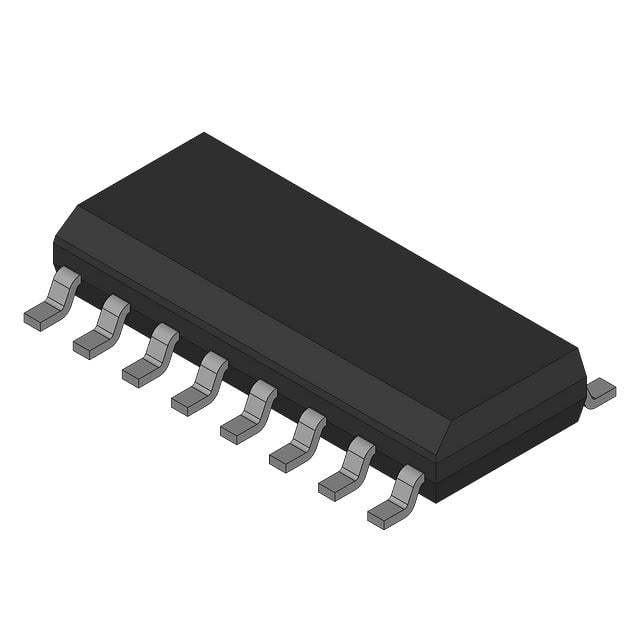
The Fairchild Semiconductor DM7474MX is a dual D-type flip-flop integrated circuit (IC) that is widely used in digital electronics for data storage and transfer applications. This device is part of the 74 series of logic devices, which are known for their reliability and versatility in various electronic circuits. Below is a detailed overview of the DM7474MX, including its specifications, features, and typical applications.
## Overview
The DM7474MX is a dual D flip-flop with set and reset capabilities. It is designed to store one bit of data and can be used in various applications, including data storage, data transfer, and timing applications. The flip-flops are edge-triggered, meaning they change their output state based on the input signal at the rising or falling edge of a clock signal. This characteristic makes them suitable for synchronous circuits.
## Key Specifications
1. Device Type:
- Dual D-type flip-flop with asynchronous set and reset.
2. Supply Voltage (Vcc):
- The DM7474MX operates typically at a supply voltage of 4.75V to 5.25V, making it compatible with standard TTL (Transistor-Transistor Logic) levels.
3. Input Voltage Levels:
- Logic High (VIH): Minimum 2.0V
- Logic Low (VIL): Maximum 0.8V
4. Output Voltage Levels:
- Logic High (VOH): Minimum 2.4V at a load of 2.0 mA
- Logic Low (VOL): Maximum 0.4V at a load of 2.0 mA
5. Propagation Delay:
- The typical propagation delay from the clock input to the output is around 15 ns, which indicates how quickly the output can respond to changes in the input.
6. Power Dissipation:
- The maximum power dissipation is typically around 1.0 mW per flip-flop, making it energy-efficient for various applications.
7. Temperature Range:
- The operating temperature range for the DM7474MX is typically from -40°C to +85°C, allowing it to be used in a wide range of environmental conditions.
8. Pin Configuration:
- The DM7474MX is available in a 14-pin Dual In-Line Package (DIP) configuration, which is standard for many integrated circuits. The pin configuration includes:
- Pins for the D inputs (D1, D2)
- Pins for the clock inputs (CLK1, CLK2)
- Pins for the set (SET1, SET2) and reset (RST1, RST2) inputs
- Output pins (Q1, Q2) for the stored data
- Ground (GND) and Vcc pins for power supply.
## Features
1. Asynchronous Set and Reset:
- The DM7474MX includes asynchronous set and reset inputs, allowing the user to directly control the output state regardless of the clock signal. This feature is useful for initializing the flip-flops or clearing them as needed.
2. Edge-Triggered Operation:
- The flip-flops are edge-triggered, meaning they respond to changes in the clock signal. This characteristic is essential for synchronous designs, where multiple flip-flops need to operate in unison based on a common clock.
3. High Noise Immunity:
- The DM7474MX is designed with high noise immunity, making it suitable for use in environments with electrical noise, ensuring reliable operation.
4. Compatibility:
- The DM7474MX is compatible with other TTL logic families, allowing for easy integration into existing designs without the need for additional interfacing components.
## Typical Applications
The DM7474MX is used in a variety of applications, including:
1. Data Storage:
- It can be used to store binary data in digital circuits, making it suitable for registers and memory applications.
2. Frequency Division:
- The flip-flops can be configured to create frequency dividers in clock circuits, which is useful in timing applications.
3. State Machines:
- The DM7474MX can be used in the design of finite state machines, where the output state depends on the current input and previous states.
4. Counters:
- It can be utilized in counter circuits, where the flip-flops store the count value and update it based on clock pulses.
5. Control Logic:
- The device can be employed in control logic circuits, where it helps manage the flow of data and signals in complex systems.
## Conclusion
In summary, the Fairchild Semiconductor DM7474MX is a versatile and reliable dual D-type flip-flop that plays a crucial role in digital electronics. With its edge-triggered operation, asynchronous set and reset capabilities, and compatibility with TTL logic levels, it is well-suited