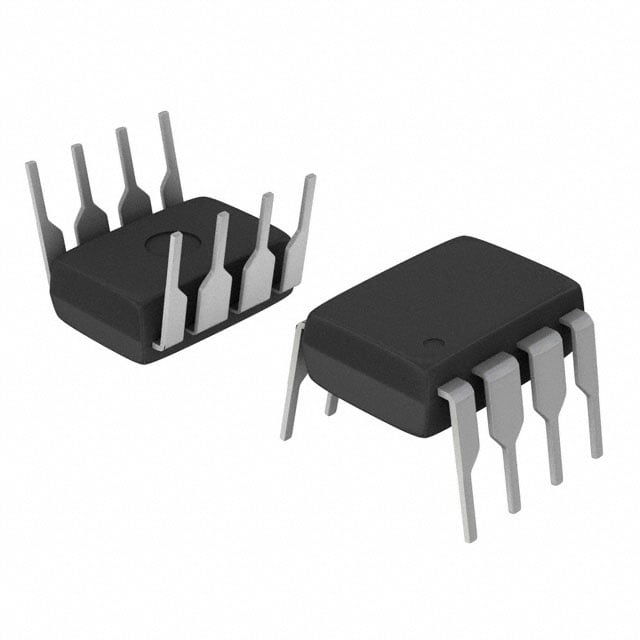
Q1: What is the Diodes Inc AS358P-E1?
A1: The Diodes Inc AS358P-E1 is a low-power, dual operational amplifier designed for use in a variety of applications requiring precision signal processing.
Q2: What is the typical application of the AS358P-E1?
A2: The AS358P-E1 is commonly used in applications such as audio amplification, signal conditioning, and sensor interfacing.
Q3: How many operational amplifiers are in the AS358P-E1?
A3: The AS358P-E1 contains two independent, high-gain, internally frequency-compensated operational amplifiers.
Q4: What is the supply voltage range for the AS358P-E1?
A4: The AS358P-E1 operates with a supply voltage range from 3V to 32V (single supply) or ±1.5V to ±16V (dual supply).
Q5: What is the power consumption of the AS358P-E1?
A5: The AS358P-E1 has a low quiescent current consumption, typically 350 µA per amplifier, making it suitable for battery-operated and energy-efficient systems.
Q6: What is the typical input offset voltage of the AS358P-E1?
A6: The AS358P-E1 has a low input offset voltage, typically around 3 mV, which ensures accurate signal processing in sensitive applications.
Q7: What is the gain bandwidth product of the AS358P-E1?
A7: The AS358P-E1 has a gain-bandwidth product of 1 MHz, providing adequate frequency response for most general-purpose applications.
Q8: What is the output swing range of the AS358P-E1?
A8: The AS358P-E1 provides an output swing that is typically within 1.5V of the supply rails when sourcing or sinking 100 µA of current, ensuring good signal integrity near supply limits.
Q9: Is the AS358P-E1 rail-to-rail?
A9: No, the AS358P-E1 is not a rail-to-rail operational amplifier. Its output does not reach the supply rails, but it provides a good swing close to the supply voltage.
Q10: What is the slew rate of the AS358P-E1?
A10: The AS358P-E1 has a slew rate of 0.3 V/µs, which is suitable for many low-speed analog applications.
Q11: Does the AS358P-E1 feature short-circuit protection?
A11: Yes, the AS358P-E1 includes short-circuit protection to prevent damage when the output is overloaded.
Q12: What is the typical output drive capability of the AS358P-E1?
A12: The AS358P-E1 can drive loads of up to 10 kΩ, making it suitable for a wide range of standard signal-processing applications.
Q13: Can the AS358P-E1 be used in automotive applications?
A13: Yes, the AS358P-E1 is suitable for automotive applications, as it is designed to operate reliably within the temperature range of -40°C to +125°C.
Q14: What is the package type for the AS358P-E1?
A14: The AS358P-E1 is available in an 8-pin SOIC (Small Outline Integrated Circuit) package, ideal for compact circuit designs.
Q15: What are the key features of the AS358P-E1?
A15: Key features of the AS358P-E1 include low power consumption, low input offset voltage, and good output drive capability for precision analog applications.
Q16: Does the AS358P-E1 require external compensation?
A16: No, the AS358P-E1 is internally frequency-compensated, eliminating the need for external compensation components.
Q17: What is the typical common-mode input voltage range for the AS358P-E1?
A17: The AS358P-E1 typically operates with a common-mode input voltage range that extends from 0V to (V+ - 2V), ensuring flexibility in signal conditioning.
Q18: What is the noise performance of the AS358P-E1?
A18: The AS358P-E1 has low noise characteristics, making it suitable for applications where signal integrity is critical, such as audio and sensor circuits.
Q19: Can the AS358P-E1 be used in medical devices?
A19: Yes, the AS358P-E1 is suitable for medical applications, particularly in signal conditioning, where low power consumption and high precision are important.
Q20: What is the typical output current of the AS358P-E1?
A20: The AS358P-E1 can source or sink a maximum output current of 20 mA, making it suitable for driving small loads in analog applications.