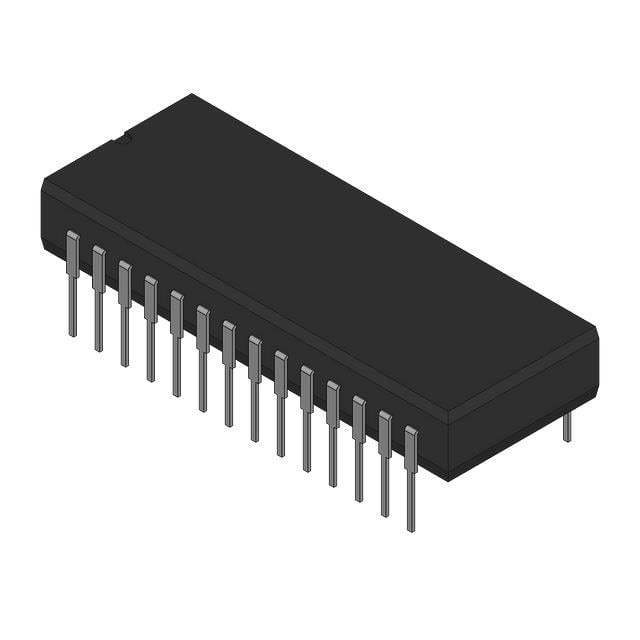
Q1: What type of device is the Analog Devices AD9002AD?
A: The AD9002AD is a high-speed, 12-bit analog-to-digital converter (ADC) designed for applications requiring precise and fast signal digitization.
Q2: What is the maximum sampling rate of the AD9002AD?
A: The AD9002AD supports sampling rates up to 65 MSPS (Mega Samples Per Second), making it suitable for high-speed data acquisition and real-time processing.
Q3: What is the resolution of the AD9002AD?
A: This ADC offers 12-bit resolution, providing fine granularity for accurate analog signal representation in digital form.
Q4: What input configuration does the AD9002AD support?
A: The AD9002AD features differential analog inputs, which enhance noise rejection and improve signal fidelity in precision applications.
Q5: What package does the AD9002AD come in?
A: It is available in a 28-lead plastic dual in-line package (PDIP), suitable for compact and high-density PCB layouts.
Q6: What are the primary applications of the AD9002AD?
A: It is commonly used in digital oscilloscopes, medical imaging equipment, radar systems, communications systems, and other high-speed data acquisition platforms.
Q7: How does the AD9002AD maintain signal integrity at high speeds?
A: Its low-noise architecture, high linearity, and differential input configuration ensure accurate conversion and minimal distortion even at fast sampling rates.
Q8: What type of output interface does the AD9002AD provide?
A: The AD9002AD provides a parallel CMOS output, enabling direct connection to DSPs, FPGAs, and other digital processing systems for high-throughput applications.
Q9: Can the AD9002AD operate in real-time digital signal processing systems?
A: Yes, the high-speed conversion and low-latency output make it ideal for real-time DSP applications requiring fast and precise measurements.
Q10: What is the typical power consumption of the AD9002AD?
A: The AD9002AD consumes approximately 420 mW during full-speed operation, providing a balance between performance and efficiency for high-speed designs.
Q11: How does the AD9002AD perform in terms of signal-to-noise ratio (SNR)?
A: The ADC offers a high SNR, typically around 70 dB, ensuring that digitized signals maintain high fidelity and minimal noise.
Q12: Is the AD9002AD suitable for multi-channel ADC systems?
A: Yes, its fast sampling and high linearity allow it to be integrated into synchronized multi-channel acquisition systems.
Q13: What reference voltage options are available for the AD9002AD?
A: The AD9002AD supports both internal and external voltage references, allowing precise scaling of the input signal range for different applications.
Q14: Can the AD9002AD operate over a wide temperature range?
A: Yes, it is rated for industrial temperature ranges from -40°C to +85°C, making it suitable for harsh environmental conditions.
Q15: How does the AD9002AD handle total harmonic distortion (THD)?
A: The ADC exhibits low THD, typically below -70 dB, providing accurate and linear conversion for high-fidelity analog signals.
Q16: What input voltage range does the AD9002AD support?
A: The differential input voltage range is typically ±0.5 V to ±2 V, depending on the applied reference and application needs.
Q17: How does the AD9002AD integrate with FPGA systems?
A: Its parallel CMOS output interface allows direct connection to FPGA input banks for high-speed, real-time data processing.
Q18: Is the AD9002AD suitable for radar signal acquisition?
A: Yes, its 65 MSPS sampling rate and high linearity make it ideal for radar applications requiring fast, accurate digitization of high-frequency signals.
Q19: Can the AD9002AD be used in medical imaging systems?
A: Yes, the high resolution, fast sampling, and low noise characteristics make it suitable for precise imaging applications such as ultrasound and MRI systems.
Q20: Why choose the Analog Devices AD9002AD for high-speed ADC applications?
A: The AD9002AD combines 12-bit resolution, 65 MSPS sampling rate, low noise, high linearity, and robust differential inputs, making it ideal for demanding real-time signal processing, instrumentation, and communication applications.