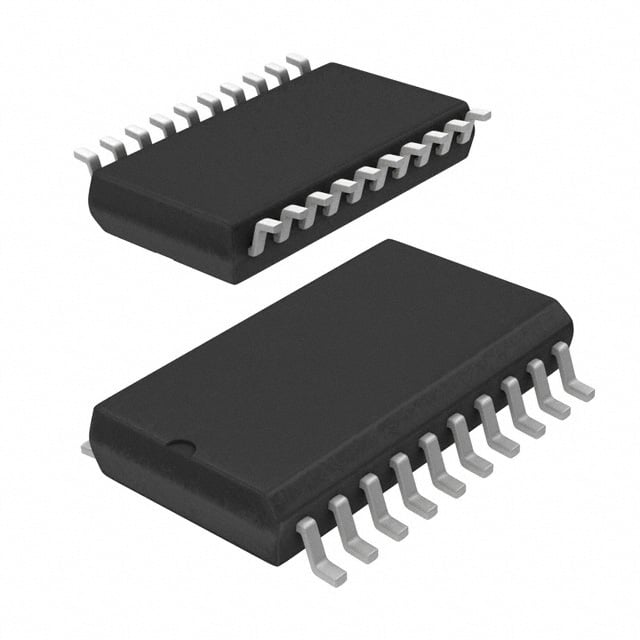
The Nexperia 74HCT574D,653 is an octal D-type flip-flop with a 3-state output, designed for high-speed, low-power logic applications. It belongs to the 74HCT logic family, which combines the high-speed characteristics of the HCT series with TTL-compatible input levels. This device is widely used in memory buffering, register storage, bus interfacing, and data latching applications within digital systems. Its combination of fast propagation times, low input currents, and high noise immunity makes it suitable for both commercial and industrial electronics.
## Functional Description
The 74HCT574 is composed of eight edge-triggered D-type flip-flops, each with a separate data input (D0–D7) and a corresponding output (Q0–Q7). All flip-flops share a common clock (CP) and output enable (OE) input. On the rising edge of the clock, data present on each D input is latched to the corresponding Q output. When OE is low, the outputs remain active; when OE is high, the outputs enter a high-impedance state, allowing the device to interface with shared bus lines without contention. This 3-state capability is critical for bus-oriented systems and multiplexed data environments.
## Pin Configuration
The 74HCT574D,653 is supplied in multiple packages including the SO16 (small outline) and PDIP16 (dual in-line) formats. The pin assignments include:
* Pins D0–D7: Data inputs for the eight flip-flops
* Pins Q0–Q7: Data outputs corresponding to each flip-flop
* CP: Clock input, rising-edge triggered
* OE: Output enable, active low
* VCC: Supply voltage (typically 5 V)
* GND: Ground reference
The pinout ensures straightforward PCB routing for both parallel and bus-connected designs.
## Electrical Characteristics
The device operates over a supply voltage range of 4.5 V to 5.5 V. Key electrical parameters include:
* Typical supply current (ICC): 20 μA
* Input high voltage (VIH): 2.0 V minimum for a logic high
* Input low voltage (VIL): 0.8 V maximum for a logic low
* Maximum output high voltage (VOH) at I_OH = –4 mA: 2.4 V minimum
* Maximum output low voltage (VOL) at I_OL = 4 mA: 0.4 V maximum
The 74HCT574D,653 exhibits TTL-compatible inputs and CMOS-level outputs, allowing seamless integration with mixed logic families while maintaining low power dissipation.
## Timing Specifications
High-speed performance is a hallmark of the 74HCT574. Typical timing parameters at VCC = 5 V and TA = 25°C include:
* Propagation delay from clock to Q (t_PHL / t_PLH): 14 ns typical
* Data setup time (t_su) before clock rising edge: 4 ns minimum
* Data hold time (t_h) after clock rising edge: 1 ns minimum
* Output enable to valid output time (t_PZ): 15 ns typical
* Output disable from valid output (t_PZ) to high-impedance (t_PZ) transition: 15 ns typical
These parameters enable high-frequency operation, suitable for 50 MHz or higher clock domains in synchronous systems.
## Power and Thermal Characteristics
The 74HCT574 demonstrates low power consumption, typically 20 μA ICC in static operation and minimal dynamic power dissipation due to efficient CMOS design. The maximum power dissipation is rated at 500 mW for the SO16 package. Its thermal resistance (junction to ambient) is approximately 120°C/W for the SO16 package, allowing reliable operation without specialized heatsinking under typical PCB conditions. The device is rated for continuous operation over a commercial temperature range of 0°C to +70°C and industrial temperature range of –40°C to +85°C.
## Functional Applications
The octal D-type flip-flop with 3-state output is widely used in:
* Data latching and temporary storage in microprocessor and microcontroller systems
* Bus interfacing where multiple devices share common lines
* Memory address or data buffering to synchronize signals
* Digital signal processing pipelines where controlled timing is required
* Edge-triggered control logic for system synchronization
The 3-state output enables multiple devices to connect to a single data bus without interference, facilitating modular and scalable digital designs.
## Noise Immunity and Reliability
The 74HCT574D,653 offers high noise margins typical of the HCT family, with VIH and VIL compatible with TTL standards, ensuring robust operation in electrically noisy environments. It exhibits high ESD tolerance, typically exceeding 2000 V HBM (human body model) and 200 V MM (machine model), providing reliable handling and assembly characteristics. The device’s CMOS structure ensures minimal leakage currents and low susceptibility to latch-up.
## Integration and Design Considerations
When incorporating the 74HCT574D,653 into a design, the clock edge must be carefully controlled to avoid metastability or race conditions. Output enable timing should be coordinated with other bus devices to prevent transient conflicts. Pull-up or pull-down resistors may be applied to unused inputs to avoid floating states, which could increase dynamic power consumption or induce spurious transitions. Proper decoupling capacitors near VCC and GND pins improve signal integrity and reduce susceptibility to switching noise.
## Summary
The Nexperia 74HCT574D,653 is a high-speed, octal D-type flip-flop with 3-state outputs, providing robust, low-power storage and bus interfacing capabilities for digital systems. Its TTL-compatible inputs, fast propagation delays, low static and dynamic power consumption, and versatile packaging make it suitable for a broad range of applications including memory buffering, data latching, and bus interfacing. Its reliability, industrial temperature range, and ESD protection ensure consistent performance in both commercial and industrial environments.