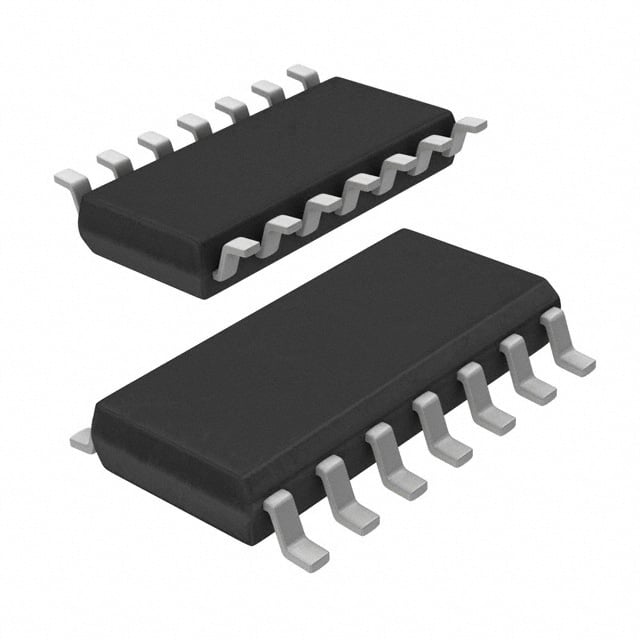
The 74HC595D is an 8-bit serial-in, parallel-out shift register with output latches and is part of the 74HC (High-speed CMOS) logic family from Toshiba Semiconductor. This device is primarily used for expanding the number of output pins in a digital circuit, allowing for easy control of multiple devices such as LEDs, motors, or other digital peripherals. The 74HC595D is commonly utilized in microcontroller-based projects where controlling a large number of outputs with fewer I/O pins is necessary, making it highly suitable for a variety of embedded applications.
## Key Specifications:
1. Device Type:
* Shift Register: 8-bit serial-in, parallel-out shift register.
* Output Type: Latched outputs that are capable of sourcing or sinking current to control external devices like LEDs.
* Family: High-speed CMOS (HC) logic family.
2. Supply Voltage:
* Operating Voltage Range: The device operates between 2V and 6V, with a typical operating voltage of 5V.
* Vcc: Power supply voltage, typically 5V in most applications.
3. Data Handling:
* Serial Input: Data is input to the 74HC595D serially (one bit at a time) through a single data pin, allowing for efficient use of limited I/O pins.
* Data Output: The data is shifted into an internal shift register and then latched into the output register, providing a parallel output of the shifted bits.
* Clock Inputs:
* Shift Register Clock (SH\_CP): The clock pin that shifts data into the register on each rising edge.
* Latch Clock (ST\_CP): The latch clock pin that transfers data from the shift register to the output register on the rising edge.
* Output Enable (OE): A pin used to disable the outputs when low (for three-state operation).
4. Output Characteristics:
* Output Pins: 8 parallel output pins, each capable of driving up to 6mA (sourcing) or sinking up to 6mA.
* High-Level Output Voltage (VOH): Typically 3.5V at 3.5mA (for Vcc = 5V).
* Low-Level Output Voltage (VOL): Typically 0.25V at 6mA (for Vcc = 5V).
* Output Impedance: The output impedance is suitable for driving small loads like LEDs, small motors, or other logic inputs.
5. Control Pins:
* Shift Register Clock (SH\_CP): Controls the shifting of data into the shift register.
* Storage Register Clock (ST\_CP): Controls the latching of the shifted data into the output registers.
* Serial Data Input (DS): The pin through which serial data is input into the shift register.
* Output Enable (OE): When this pin is low, it enables the output pins. When high, the outputs are in a high-impedance (tri-state) condition, effectively disconnected from the circuit.
6. Temperature Range:
* Operating Temperature: Typically from -40°C to +85°C, which makes the 74HC595D suitable for a wide range of applications, including industrial and automotive systems.
* Storage Temperature: -65°C to +150°C.
7. Package Type:
* The 74HC595D is typically available in a DIP-16 package or SOIC-16 package, offering 16 pins.
* The pinout is standard for CMOS logic devices, and it’s designed for both through-hole and surface-mount applications.
8. Shift Register Functionality:
* The shift register is capable of storing 8 bits of data (1 byte) and transferring it to the parallel output pins upon the activation of the latch clock.
* This enables the device to act as a serial-to-parallel converter, making it ideal for situations where you need to control multiple devices from a single microcontroller I/O pin.
9. Current Consumption:
* Typical Supply Current (Icc): Approximately 4 µA when in static operation.
* The device consumes very little power, especially in standby mode, making it suitable for battery-powered applications.
10. Power Consumption and Efficiency:
* The 74HC595D operates with low power consumption, typically drawing around 4mA during operation, and even less in idle states.
* Its CMOS design ensures low quiescent current, making it ideal for use in energy-efficient circuits.
## Functional Features:
1. Serial-to-Parallel Data Conversion:
* The 74HC595D allows serial data input, with each incoming bit being stored in an 8-bit shift register. Once 8 bits are shifted into the register, they can be transferred to the output pins, enabling parallel data outputs.
* This is useful in situations where microcontrollers or digital systems have limited output pins but need to control multiple devices.
2. Cascade Capabilities (Daisy-chaining):
* The 74HC595D can be cascaded to create wider shift registers by connecting the QH' pin (serial output) of one shift register to the DS pin (serial input) of the next shift register.
* This allows for control of more output devices using fewer microcontroller pins. For instance, you can chain multiple 74HC595D chips to control 16, 24, or even 64 output pins.
3. Latch Functionality:
* Data shifted into the shift register can be latched to the output registers using the storage register clock (ST\_CP), allowing for controlled data timing and enabling synchronous control of multiple devices.
* The latch enables the separation of shifting and latching operations, allowing for non-interfering data handling and control.
4. Three-State Output:
* The output pins can be put into a high-impedance state by setting the OE pin high. This feature is useful when multiple devices need to share the same output lines, as only one device can actively drive the line at a time.
5. Sourcing and Sinking Capability:
* The outputs of the 74HC595D are capable of sourcing or sinking current, making it possible to control both active-low and active-high devices, such as LEDs, relays, and other digital peripherals.
## Applications:
1. LED Control:
* The 74HC595D is commonly used in controlling multiple LEDs. By daisy-chaining multiple shift registers, a single microcontroller can control hundreds of LEDs in a matrix configuration.
2. Relay Control:
* It can be used to control relays for switching larger loads. Cascading multiple 74HC595D devices allows for controlling multiple relay channels using only a few microcontroller pins.
3. Motor Control:
* The shift register can be used to control multiple motors or actuators, particularly in robotics and automation.
4. Data Display:
* It is useful in driving 7-segment displays or other similar types of digital displays. The parallel output allows for efficient driving of each segment.
5. Audio and Video Applications:
* Used for controlling audio equipment, switches, or for applications where parallel control of devices is necessary, such as in multimedia systems.
6. Peripheral Expansion:
* The 74HC595D is ideal for peripheral expansion in digital circuits, where the microcontroller has limited GPIOs but needs to control many devices like switches, LEDs, or other digital outputs.
## Conclusion:
The 74HC595D is a versatile and efficient serial-to-parallel shift register, capable of expanding the output capabilities of a microcontroller or logic circuit. With its simple interface, ability to cascade for expanded control, low power consumption, and wide range of applications, the 74HC595D is a popular choice in embedded systems for managing numerous outputs with minimal microcontroller pin usage. Whether used for controlling LEDs, driving relays, or interfacing with larger systems, this shift register provides an effective solution for many digital control needs.