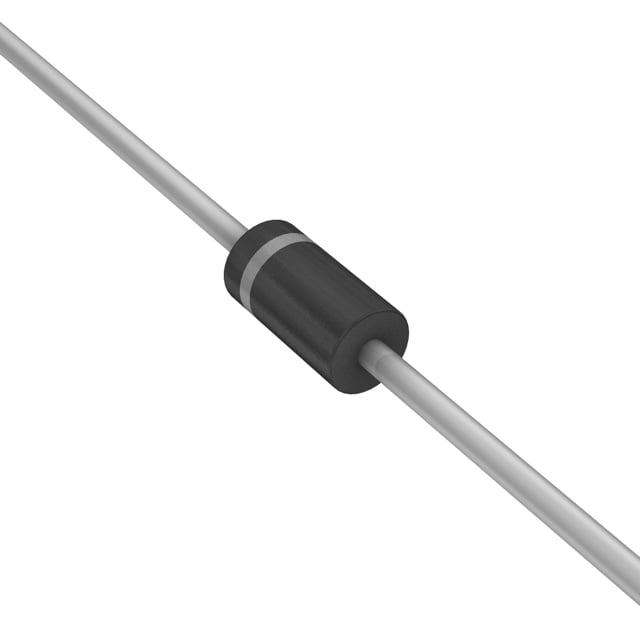
A DIAC (short for "Diode for Alternating Current") is a two-terminal semiconductor device that acts as a bidirectional switch, conducting current in both directions when the applied voltage exceeds its breakover voltage. Let%27s delve into the details:
1. Symbol of DIAC:
- The symbol of a DIAC resembles two diodes placed in antiparallel.
- It has two terminals: A1 (MT1) and A2 (MT2). The abbreviation "MT" stands for main terminals.
- Unlike regular diodes, the DIAC lacks an anode or cathode terminal. Instead, it turns on and off by varying the terminal voltage above or below its breakover voltage.
2. Construction of DIAC:
- The DIAC is a five-layer device formed by combining two antiparallel SCRs (Silicon-Controlled Rectifiers) without gate terminals.
- It has only two terminals: MT1 and MT2.
- The DIAC can be constructed in either a 3-layer or 5-layer symmetrical structure:
- 3-layer structure: Sandwiches N or P layers between alternating layers, forming a PNP or NPN structure. The breakover voltage of this type of DIAC is around 30 volts.
- 5-layer structure: Combines two SCRs without gate terminals. It consists of 2 P-layers and 3 N-layers, with equal doping and width in all layers. This symmetrical structure provides switching capabilities in both forward and reverse polarity.
3. Working of DIAC:
- The DIAC conducts current in both directions unless the applied voltage falls below the breakover voltage.
- When the applied voltage at MT1 is positive with respect to MT2, the junctions at the ends become forward-biased, and the middle junction becomes reverse-biased.
- The DIAC is mainly used for triggering other devices, such as TRIACs, due to its symmetrical switching characteristics.
4. V-I Characteristics of DIAC:
- The voltage-current (V-I) characteristics of a DIAC show a sharp increase in current once the breakover voltage is exceeded.
- Below the breakover voltage, the DIAC remains non-conductive.
5. Advantages & Disadvantages of DIAC:
- Advantages:
- Bidirectional switching capability.
- Symmetrical behavior.
- Used for triggering TRIACs.
- Disadvantages:
- Uncontrolled switching (no gate terminal).
- Limited applications due to its specific use as a trigger device.
6. Applications of DIAC:
- Motor Speed Control: DIACs are used in motor speed controllers, where they trigger TRIACs to regulate AC motor speeds.
- Light Dimmers: DIACs assist in controlling the brightness of incandescent lamps.
- Voltage Stabilization: They find applications in voltage stabilizers and surge protectors.
Remember, the DIAC is an uncontrolled switch, and its primary purpose lies in triggering other devices rather than amplification or controlled switching¹²³⁴⁵.
------------------------------
(1) What is DIAC? Symbol, Construction, Working and Applications. https://www.electricaltechnology.org/2021/08/diac.html.
(2) Diac, Symbol, Construction, Working and Characteristics. https://www.learnelectronicswithme.com/2020/08/diac-symbol-construction-working-and.html.
(3) DIAC | A Beginner%27s Guide | Symbol, Working, Applications. https://www.electronicshub.org/diac/.
(4) DIAC (Diode A.C. Switch): Circuit symbol, Construction ... - BrainKart. https://www.brainkart.com/article/DIAC-(Diode-A-C--Switch)--Circuit-symbol,-Construction,-Operation,-V--I-characteristics,-Applications_12538/.
(5) DIAC – Symbol, Construction, Working with Application Circuits. https://components101.com/articles/diac-symbol-construction-working-and-application-circuits.
icDirectory United Kingdom | https://www.icdirectory.co.uk/a/blog/what-is-the-symbol-for-a-diac.html

☰