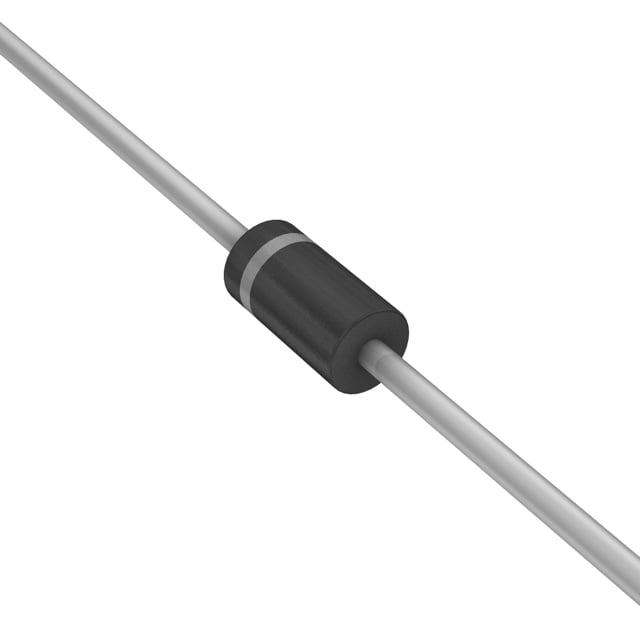
Let%27s explore the voltage-triggered switching behavior of DIACs in detail.
1. What is a DIAC?
- The DIAC (Diode for Alternating Current) is a bidirectional semiconductor device designed to break down when the AC voltage across it exceeds a certain level, allowing current to flow in either direction.
- Unlike unidirectional devices like thyristors (such as SCRs), DIACs are specifically tailored for AC circuits.
- They play a crucial role in power regulation for AC loads, such as controlling motor speeds or light dimming.
- DIACs are often used in conjunction with TRIACs due to their symmetrical switching characteristics.
2. Symbol and Construction of DIAC:
- The DIAC symbol resembles two diodes in antiparallel.
- It has two terminals: A1 (MT1) and A2 (MT2).
- Since it can conduct in both directions, there are no distinct anode or cathode terminals.
- Unlike thyristors, DIACs lack a control or gate terminal.
- DIACs turn on and off by increasing or decreasing the terminal voltage above or below their breakover voltage.
3. Working Principle:
- DIACs can conduct current in both directions unless the applied voltage falls below the breakover voltage.
- When the applied voltage at MT1 is positive with respect to MT2:
- The junctions at the ends become forward-biased.
- The middle junction becomes reverse-biased.
- DIACs offer symmetrical switching capabilities in both forward and reverse polarity.
- Unlike SCRs or TRIACs, DIACs do not switch sharply to a low voltage condition at low current levels.
- The on-state voltage drop remains low until the current falls below the holding current level.
- Voltage drop decreases with increasing current.
4. Applications of DIACs:
- Phase Control: DIACs are crucial for phase control in AC circuits.
- By applying a short pulse of gate current at a pre-set trigger point, the mean value of the load current can be varied.
- This method is commonly used for light dimming and motor speed control.
- Switch Mode Power Supplies: DIACs are used in conjunction with capacitors to trigger TRIACs.
- The output voltage can be regulated by varying the time at which the TRIAC is triggered.
5. Characteristics of DIACs:
- Breakover Voltage (VBR): The voltage at which DIACs start conducting heavily.
- Bidirectional Conduction: DIACs allow current flow in both directions.
- Instant Trigger Pulse: DIACs provide a sharper trigger pulse compared to a steadily rising ramp voltage.
- No Amplification: DIACs do not amplify signals; they act as switching devices.
In summary, DIACs are versatile components that facilitate bidirectional switching in AC circuits. Their symmetrical characteristics contribute to efficient power regulation, making them valuable for various applications.
For more information, you can refer to the following sources:
- [Electronics Tutorials](https://www.electronics-tutorials.ws/power/diac.html) ¹
- [Electricity-Magnetism](https://www.electricity-magnetism.org/diac/) ²
- [Electronics Hub](https://www.electronicshub.org/diac/) ³
- [Electronic Clinic](https://www.electroniclinic.com/diac-construction-working-and-uses/) ⁴<br>- [Electrical Technology](https://www.electricaltechnology.org/2021/08/diac.html) ⁵<br>
------------------------------
(1) Diac Triac and Quadrac for AC Power Control. https://www.electronics-tutorials.ws/power/diac.html.
(2) DIAC | Electricity - Magnetism. https://www.electricity-magnetism.org/diac/.
(3) DIAC | A Beginner%27s Guide | Symbol, Working, Applications. https://www.electronicshub.org/diac/.
(4) DIAC construction, Working, and Uses - Electronic Clinic. https://www.electroniclinic.com/diac-construction-working-and-uses/.
(5) What is DIAC? Symbol, Construction, Working and Applications. https://www.electricaltechnology.org/2021/08/diac.html.
icDirectory United Kingdom | https://www.icdirectory.co.uk/a/blog/how-does-the-diac-handle-voltage-triggered-switching.html

☰