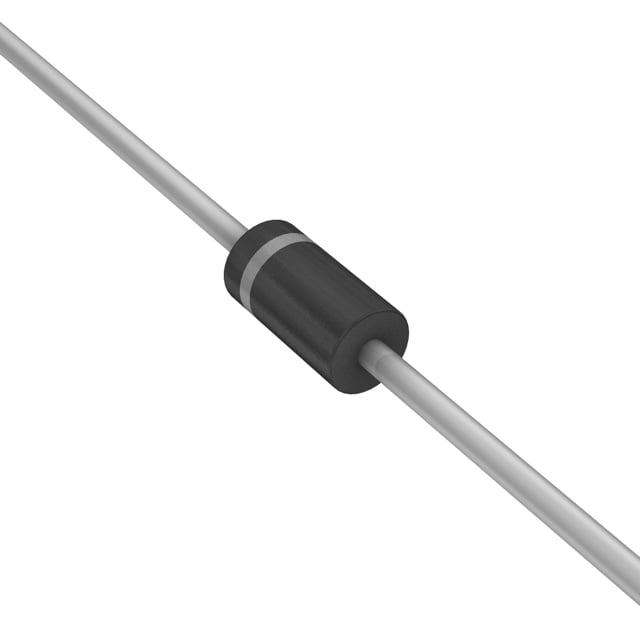
Let%27s delve into the switching characteristics of DIACs in detail.
1. What is a DIAC?
- The term DIAC stands for Diode for Alternating Current.
- It is a bidirectional semiconductor switch that can be turned ON in both forward and reverse directions.
- Unlike thyristors (such as SCRs), which conduct in only one direction, DIACs are specifically designed for AC circuits.
- DIACs play a crucial role in power regulation for AC loads, such as controlling motor speeds.
- They are often used in conjunction with TRIACs due to their symmetrical switching characteristics.
2. Symbol of DIAC:
- The DIAC symbol resembles two diodes in antiparallel.
- It has two terminals: A1 (MT1) and A2 (MT2).
- Since it can conduct in both directions, there are no distinct anode or cathode terminals.
- Unlike thyristors, DIACs lack a control or gate terminal.
- DIACs turn on and off by increasing or decreasing the terminal voltage above or below their breakover voltage.
3. Construction of DIAC:
- DIACs are five-layer devices formed by combining two antiparallel SCRs (without gate terminals).
- They have only two terminals: MT1 and MT2.
- The symmetrical structure ensures equal widths of regions and doping percentages from both terminals.
- DIACs can be constructed in either a 3-layer or 5-layer symmetrical structure:
- 3-layer structure: Sandwiches N or P layers between alternating layers, forming a PNP or NPN structure. Breakover voltage is around 30 volts.
- 5-layer structure: Combines two SCRs without gate terminals. It consists of 2 P-layers and 3 N-layers, with equal doping and width in all layers.
4. Working of DIAC:
- DIACs can conduct current in both directions unless the applied voltage falls below the breakover voltage.
- When the applied voltage at MT1 is positive with respect to MT2:
- The junctions at the ends become forward-biased.
- The middle junction becomes reverse-biased.
- DIACs offer symmetrical switching capabilities in both forward and reverse polarity.
- They do not switch sharply to a low voltage condition at low current levels (unlike SCRs or TRIACs).
- The on-state voltage drop remains low until the current falls below the holding current level.
- Voltage drop decreases with increasing current.
5. Advantages of DIAC:
- Symmetrical switching: Reduces harmonics in a system.
- Low on-state voltage drop: Increases with voltage but remains manageable.
- Easy switching: Controlled by varying the applied voltage.
- Smooth power control: Useful for triggering other thyristors.
In summary, DIACs are versatile components that facilitate bidirectional switching in AC circuits, making them valuable for motor control, light dimming, and other applications. Their symmetrical characteristics contribute to efficient power regulation.
For more information, you can refer to the following sources:
- [Electrical Technology](https://www.electricaltechnology.org/2021/08/diac.html) ¹
- [Components101](https://components101.com/articles/diac-symbol-construction-working-and-application-circuits) ²
- [Electrical4U](https://www.electrical4u.com/diac/) ³
- [Electronics Hub](https://www.electronicshub.org/diac/) ⁴<br>
------------------------------
(1) What is DIAC? Symbol, Construction, Working and Applications. https://www.electricaltechnology.org/2021/08/diac.html.
(2) DIAC – Symbol, Construction, Working with Application Circuits. https://components101.com/articles/diac-symbol-construction-working-and-application-circuits.
(3) DIAC: What is it? (Applications & Working Principle). https://www.electrical4u.com/diac/.
(4) DIAC | A Beginner%27s Guide | Symbol, Working, Applications. https://www.electronicshub.org/diac/.
icDirectory United Kingdom | https://www.icdirectory.co.uk/a/blog/what-are-the-switching-characteristics-of-diacs.html

☰