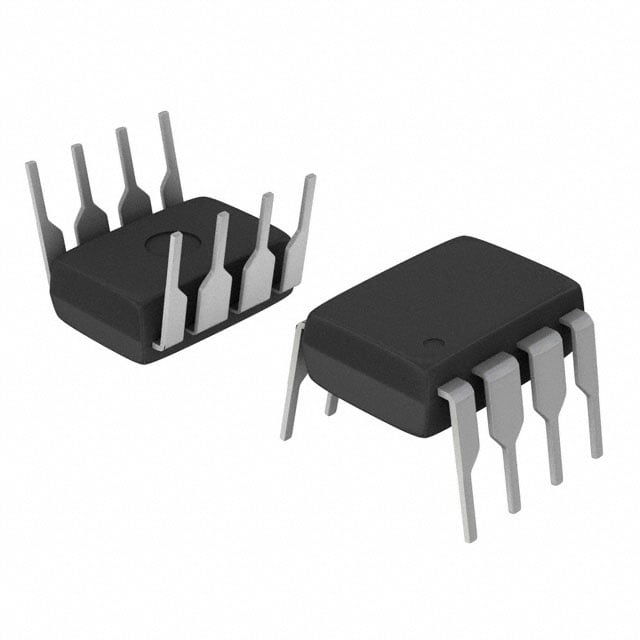
The Vishay TCET1200 is an optoelectronic sensor module consisting of an infrared emitter and a phototransistor detector, designed for reflective object detection and proximity sensing. It is optimized for industrial, automation, and consumer applications where reliable detection of objects, position, or motion is required. The device integrates the emitter and detector in a single package with precise alignment, providing stable optical performance and ease of integration into sensing systems. Its compact form factor, high responsivity, and fast response time make it suitable for encoder systems, limit switches, object counting, and non-contact detection applications.
## Device Architecture
The TCET1200 comprises a gallium arsenide (GaAs) infrared light-emitting diode (LED) as the emitter and a silicon phototransistor as the detector, encapsulated in a black plastic housing to minimize ambient light interference. The emitter and detector are positioned at a fixed angle, ensuring consistent optical alignment and predictable reflective characteristics. The phototransistor operates in photoconductive mode, providing a current output proportional to the incident infrared light reflected from a target surface. The package features a transparent window over the emitter and detector area, enhancing optical efficiency and minimizing losses due to internal reflections or scattering.
## Electrical Characteristics
The infrared emitter operates typically at a forward voltage of 1.2 V to 1.4 V at a continuous forward current of 20 mA, with a peak forward current capability of 100 mA for short pulses. Radiant intensity is typically 0.8 mW/sr at a 20 mA drive current. The phototransistor exhibits a collector-emitter breakdown voltage of 30 V and a maximum collector current of 50 mA. Dark current is typically in the range of 50 nA, ensuring high sensitivity even at low light levels. The phototransistor has a current transfer ratio (CTR) between the emitter optical power and the collector current, allowing design of signal conditioning circuits without complex amplification. The device operates over a wide supply voltage range compatible with standard digital and analog circuits.
## Optical and Performance Characteristics
The TCET1200 is optimized for reflective sensing applications, with an emitter wavelength centered at 950 nm to maximize reflection from standard surfaces while minimizing interference from ambient visible light. The detection field of the phototransistor is defined by the package geometry, providing an angular detection range suitable for close-proximity sensing. Typical response times are 10 μs rise and 10 μs fall, allowing high-speed detection and rapid encoder signal acquisition. The emitter and detector combination provides a contrast ratio sufficient to distinguish objects with reflectivity variations as small as 10%, enabling reliable operation across diverse materials and surface finishes.
## Temperature and Environmental Performance
The TCET1200 is specified to operate over an ambient temperature range from -40°C to +85°C, supporting automotive, industrial, and outdoor applications. The package material is resistant to thermal cycling, moisture, and mechanical stress. The phototransistor exhibits minimal leakage current variation across the specified temperature range, ensuring consistent detection performance. The infrared LED maintains radiant intensity stability over temperature changes, aided by the low thermal resistance of the plastic encapsulation and optimized internal geometry. Extended storage conditions are supported without significant degradation of optical or electrical characteristics.
## Mechanical and Package Details
The TCET1200 is supplied in a compact, through-hole plastic package with precise emitter-detector alignment. Lead spacing and package dimensions conform to standard PCB mounting practices, simplifying integration into automated assembly processes. The package includes a black plastic housing to suppress ambient light and cross-talk, and a clear lens over the emitter and detector area to focus and collimate infrared light. The module provides robust mechanical stability against vibration and shock, ensuring reliable operation in dynamic environments. Pin configuration supports emitter and collector connections for easy interfacing with driver and signal processing circuits.
## Applications
The TCET1200 is well-suited for a variety of sensing applications where non-contact detection is required. Typical use cases include:
* Reflective object detection in industrial automation systems
* Rotary and linear encoder systems for motion feedback
* Limit switches and position sensing in machinery
* Object counting and presence detection
* Consumer appliances requiring proximity or position detection
* Robotics and automation for obstacle detection or alignment verification
Its compact size, fast response, and robust environmental tolerance make it ideal for high-reliability applications requiring stable, repeatable sensing performance.
## Key Specifications
* Device Type: Reflective optoelectronic sensor
* Emitter Type: GaAs infrared LED, λ ≈ 950 nm
* Forward Voltage: 1.2 V to 1.4 V at 20 mA
* Forward Current: 20 mA continuous, 100 mA peak pulsed
* Radiant Intensity: 0.8 mW/sr typical at 20 mA
* Detector Type: Silicon phototransistor, photoconductive mode
* Collector-Emitter Voltage (VCEO): 30 V maximum
* Maximum Collector Current: 50 mA
* Dark Current: 50 nA typical
* Response Time: 10 μs rise/fall
* Operating Temperature Range: -40°C to +85°C
* Package: Through-hole black plastic housing with clear lens
* Applications: Reflective object detection, encoders, limit switches, position sensing, object counting, proximity detection
The Vishay TCET1200 provides a reliable, high-speed, and compact solution for reflective object detection and proximity sensing applications across industrial, automotive, and consumer domains, combining robust electrical and optical performance with precise mechanical alignment.