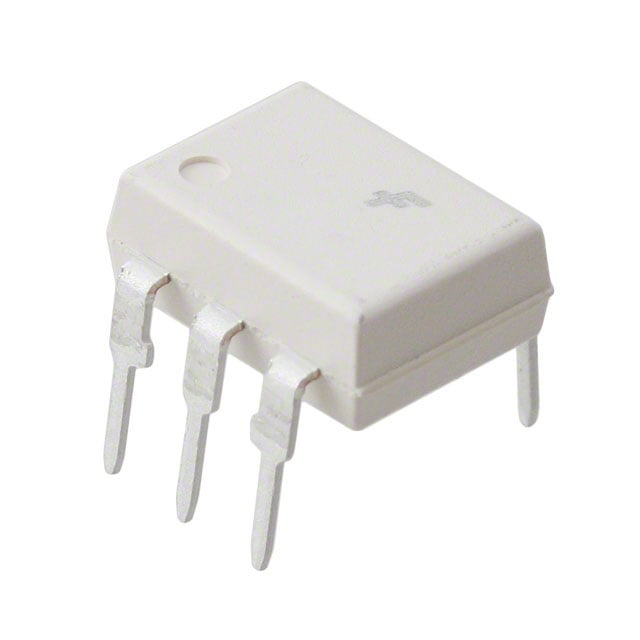
The Vishay MOC8102 is an optoisolator, also known as an optocoupler, designed to provide electrical isolation between its input and output while allowing for signal transmission. This device is particularly useful in applications where it is necessary to separate different parts of a system to prevent high voltages from affecting the low-voltage side, ensuring safety and signal integrity. Below is a detailed overview of the MOC8102, including its specifications and typical applications.
## Overview
The MOC8102 is a phototransistor optocoupler that features a gallium arsenide (GaAs) infrared LED as the input and a phototransistor as the output. The device is designed to provide high-speed switching capabilities and is suitable for a variety of applications, including signal isolation, switching power supplies, and microcontroller interfacing.
## Key Specifications
1. Input Characteristics:
- LED Forward Voltage (Vf): Typically 1.2 V at 20 mA. This is the voltage drop across the LED when it is forward-biased.
- LED Forward Current (If): Maximum of 50 mA. This is the maximum current that can safely flow through the LED.
- LED Reverse Voltage (Vr): Maximum of 5 V. This is the maximum reverse voltage that can be applied to the LED without causing damage.
2. Output Characteristics:
- Collector-Emitter Voltage (Vce): Maximum of 80 V. This is the maximum voltage that can be applied across the collector and emitter of the phototransistor.
- Collector Current (Ic): Maximum of 50 mA. This is the maximum current that can flow through the collector of the phototransistor.
- Current Transfer Ratio (CTR): Typically 100% to 600% at If = 10 mA. This ratio indicates the efficiency of the optocoupler in transferring current from the input (LED) to the output (phototransistor).
3. Isolation Voltage: The MOC8102 provides an isolation voltage of 5000 VRMS, which ensures that the input and output sides are electrically isolated, providing safety in high-voltage applications.
4. Switching Speed: The device has a rise time (tr) of approximately 5 µs and a fall time (tf) of about 5 µs, making it suitable for applications requiring moderate-speed switching.
5. Temperature Range: The operating temperature range for the MOC8102 is from -40°C to +100°C, allowing it to be used in various environmental conditions.
6. Package Type: The MOC8102 is available in a standard 6-pin DIP (Dual In-line Package) configuration, which is suitable for through-hole mounting. It is also available in surface-mount packages, making it versatile for different PCB designs.
## Applications
The Vishay MOC8102 is widely used in various applications, including:
- Signal Isolation: It is commonly used to isolate control signals in industrial automation systems, protecting sensitive components from high voltages.
- Switching Power Supplies: The MOC8102 can be used in feedback circuits of switching power supplies to provide isolation between the primary and secondary sides.
- Microcontroller Interfacing: It is often employed to interface microcontrollers with high-voltage devices, ensuring that the low-voltage control signals do not expose the microcontroller to dangerous voltages.
- Telecommunications: The device can be used in telecommunications equipment to isolate different sections of the circuit, enhancing safety and reliability.
- Data Communication: The MOC8102 is suitable for data communication applications where signal integrity and isolation are critical.
## Conclusion
The Vishay MOC8102 is a versatile optoisolator that provides reliable electrical isolation and signal transmission in various applications. With its robust specifications, including high isolation voltage, moderate switching speed, and wide operating temperature range, it is an excellent choice for designers looking to enhance safety and performance in their electronic systems. Whether used in industrial automation, power supplies, or microcontroller interfacing, the MOC8102 continues to be a valuable component in modern electronic designs.