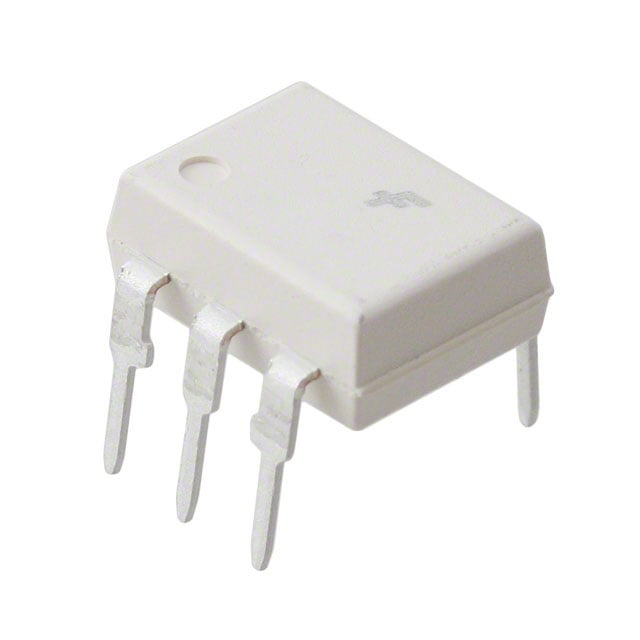
The onsemi MOC206M is an optically isolated triac driver designed to provide safe, low-power control of AC loads. It integrates an infrared LED optically coupled to a phototriac output, allowing electrical isolation between low-voltage control circuits and high-voltage AC loads. This device is widely used in switching applications for industrial, consumer, and home automation systems, enabling precise control of motors, lamps, heaters, and other AC-powered devices while ensuring operator and circuit safety.
## Device Architecture
The MOC206M employs an opto-isolated architecture combining a light-emitting diode (LED) input with a triac driver output. Key architectural features include:
* Infrared LED Input: Activated with a small forward current, providing optical signal coupling to the output stage.
* Phototriac Output: Sensitive triac capable of triggering external AC triacs or SCRs, allowing isolation of low-voltage control from high-voltage AC loads.
* Zero-Crossing Triggering Variant: Available in related models; the MOC206M triggers immediately upon LED activation, suitable for phase-angle control and dimming applications.
* High Isolation Voltage: The optical coupling provides galvanic isolation between input and output, protecting control circuitry from high-voltage transients.
## Electrical Characteristics
* Input Forward Voltage (VF): Typically 1.2 V at 10 mA, compatible with standard logic-level signals.
* Input Forward Current (IF): LED activation requires 5–15 mA, with maximum rating of 60 mA for short pulses.
* Input Reverse Voltage (VR): 6 V, ensuring protection against reverse-bias stress during handling or circuit transients.
* Output Voltage (VDRM/VRRM): 400 V maximum repetitive peak off-state voltage, allowing control of 120 V or 240 V AC loads.
* Output Current (IT(RMS)): Maximum RMS current of 100 mA for driving external triacs.
* Trigger Current (IT): Minimum current required to activate phototriac output typically 5 mA at 5 V forward LED drive.
* Isolation Voltage (VISO): 5300 VRMS between input and output, ensuring robust protection and compliance with safety standards.
## Switching Performance
* Turn-On Time (tON): Typical 2.5 µs at rated conditions, enabling fast response to input control signals.
* Turn-Off Time (tOFF): Typically 50 µs, sufficient for accurate triggering of external AC triacs.
* Operating Frequency: Suitable for mains-frequency AC control (50/60 Hz) and low-frequency switching applications.
* Capacitance and Crosstalk: Low input-to-output capacitance minimizes unwanted coupling, maintaining signal integrity for sensitive control circuits.
## Thermal and Mechanical Characteristics
* Package Type: 6-pin DIP or equivalent for through-hole mounting, providing mechanical robustness and easy assembly.
* Operating Temperature Range (TA): –40°C to +100°C, supporting industrial and consumer applications.
* Storage Temperature Range (TSTG): –55°C to +125°C.
* Thermal Management: Low power dissipation due to LED input and phototriac output, enabling operation without heat sinks in most control circuits.
## Reliability and Robustness
* Galvanic Isolation: 5300 VRMS isolation protects low-voltage control circuitry from high-voltage AC lines.
* High ESD Tolerance: Designed to withstand handling and assembly electrostatic discharge events.
* Repetitive Triggering Capability: Capable of continuous operation for high cycle-count AC switching applications.
* Industrial Reliability: Suitable for operation in environments with voltage transients, surges, and varying ambient temperatures.
## Applications
* AC load control in household appliances and industrial equipment.
* Phase-angle control for dimmers, fan speed controllers, and heater regulation.
* Isolation of microcontroller or logic-level circuits from AC mains for safety.
* Motor start/stop control, relay replacement, and lamp switching.
* Safety-critical isolation in measurement, automation, and control systems.
## Summary of Key Specifications
| Feature | Specification |
| ------------------------------------------ | ----------------------------------------------------------------------------- |
| Device | MOC206M |
| Type | Optically Isolated Triac Driver |
| Input Forward Voltage (VF) | 1.2 V typical at 10 mA |
| Input Forward Current (IF) | 5–15 mA typical, 60 mA max pulse |
| Input Reverse Voltage (VR) | 6 V |
| Output Repetitive Peak Voltage (VDRM/VRRM) | 400 V |
| Output RMS Current (IT(RMS)) | 100 mA max |
| Trigger Current (IT) | 5 mA typical |
| Isolation Voltage (VISO) | 5300 VRMS |
| Turn-On Time (tON) | 2.5 µs typical |
| Turn-Off Time (tOFF) | 50 µs typical |
| Package | 6-pin DIP through-hole |
| Operating Temperature (TA) | –40°C to +100°C |
| Storage Temperature (TSTG) | –55°C to +125°C |
| Applications | AC load switching, dimmers, motor control, industrial and consumer automation |
The onsemi MOC206M provides reliable, high-speed optically isolated control for AC loads. Its low input current requirements, fast response, high isolation voltage, and compact through-hole package make it suitable for industrial and consumer applications where safety, performance, and ease of integration are critical.