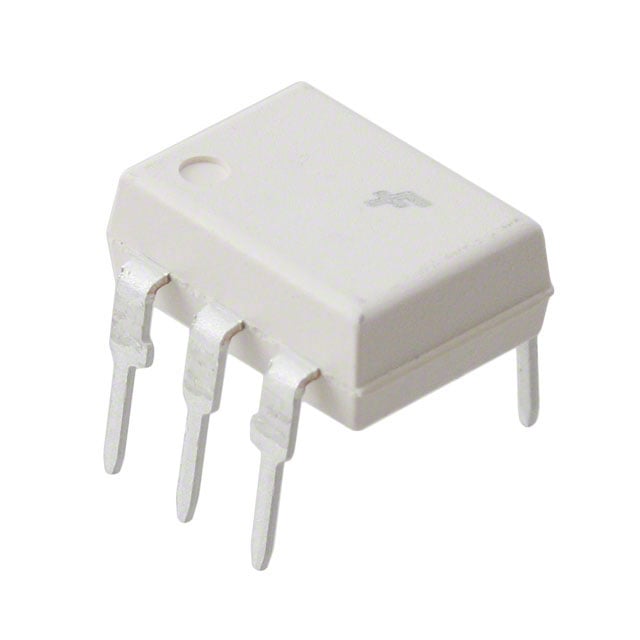
Q1: What is the Everlight Electronics H11AA2?
A1: The Everlight Electronics H11AA2 is an optocoupler (also known as an opto-isolator) designed to electrically isolate different sections of a circuit while allowing signal transmission via light. It features a phototransistor output.
Q2: What type of output does the Everlight Electronics H11AA2 have?
A2: The H11AA2 has a phototransistor output, which is designed to interface with digital circuits, providing electrical isolation between the input and output.
Q3: What is the input current range of the Everlight Electronics H11AA2?
A3: The typical input current range for the H11AA2 is from 5mA to 20mA, allowing it to be driven by standard logic-level signals.
Q4: What is the voltage range for the Everlight Electronics H11AA2?
A4: The H11AA2 operates with an input voltage range from 1.2V to 1.4V, making it suitable for low-voltage signal isolation in various systems.
Q5: What is the isolation voltage of the Everlight Electronics H11AA2?
A5: The H11AA2 provides an isolation voltage of up to 5kV RMS, offering strong isolation between the input and output, which is critical for preventing high-voltage spikes from affecting sensitive components.
Q6: What is the response time of the Everlight Electronics H11AA2?
A6: The typical rise and fall time of the H11AA2 is around 1µs, which makes it suitable for high-speed digital signal transmission.
Q7: What is the maximum collector-emitter voltage for the Everlight Electronics H11AA2?
A7: The maximum collector-emitter voltage for the H11AA2 is 80V, ensuring it can handle a wide range of voltage levels in digital circuits.
Q8: What is the maximum output current for the Everlight Electronics H11AA2?
A8: The H11AA2 can drive a maximum output current of 50mA, which is typical for optocouplers used in signal transmission applications.
Q9: What is the typical operating temperature range of the Everlight Electronics H11AA2?
A9: The typical operating temperature range for the H11AA2 is from -40°C to +85°C, making it suitable for use in a variety of industrial and commercial environments.
Q10: Does the Everlight Electronics H11AA2 have any special protection features?
A10: The H11AA2 is designed for electrical isolation, but it does not include specific internal protection features such as overcurrent protection. External components may be needed for added protection in some applications.
Q11: What package type is the Everlight Electronics H11AA2 available in?
A11: The H11AA2 is available in a 4-pin DIP (Dual In-line Package) form, which is easy to handle for manual and automated soldering processes.
Q12: Can the Everlight Electronics H11AA2 be used in high-speed communication systems?
A12: Yes, the H11AA2 can be used in high-speed communication systems, as it has fast switching times (typically around 1µs), making it suitable for digital signal isolation.
Q13: What is the CTR (Current Transfer Ratio) of the Everlight Electronics H11AA2?
A13: The H11AA2 typically has a current transfer ratio (CTR) ranging from 50% to 600%, depending on the input current, which indicates the efficiency of signal transmission from input to output.
Q14: Is the Everlight Electronics H11AA2 RoHS compliant?
A14: Yes, the H11AA2 is RoHS compliant, meaning it is free from hazardous substances like lead, ensuring it meets modern environmental and safety standards.
Q15: What are the typical applications for the Everlight Electronics H11AA2?
A15: Typical applications for the H11AA2 include signal isolation in microcontroller systems, data transmission, power supply regulation, and safety isolation in industrial control systems.
Q16: What is the typical power dissipation of the Everlight Electronics H11AA2?
A16: The typical power dissipation of the H11AA2 is around 30mW when operating under standard conditions, which makes it suitable for low-power applications.
Q17: Does the Everlight Electronics H11AA2 have a high isolation resistance?
A17: Yes, the H11AA2 has a high isolation resistance, typically greater than 10^12 ohms, ensuring reliable isolation between input and output.
Q18: Can the Everlight Electronics H11AA2 be used in AC circuits?
A18: The H11AA2 is designed primarily for DC signal isolation but can be used in AC circuits if the signal is properly conditioned and within the component's voltage and current limits.
Q19: What are the main benefits of using the Everlight Electronics H11AA2 in a design?
A19: The main benefits of using the H11AA2 include high voltage isolation, fast switching, low power consumption, and a compact package that makes it suitable for a variety of space-constrained and noise-sensitive applications.
Q20: How does the Everlight Electronics H11AA2 achieve electrical isolation?
A20: The H11AA2 achieves electrical isolation by using light transmission through an LED (Light Emitting Diode) to transfer signals to a phototransistor on the output side, ensuring that electrical noise or voltage spikes on the input side do not affect the output circuit.