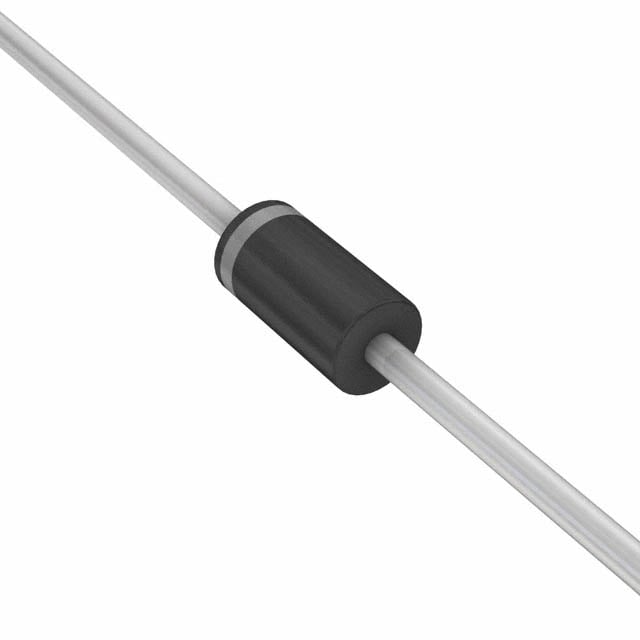
Let%27s explore the use of germanium diodes for rectification in detail:
1. What is a Germanium Diode?
- A germanium diode is a type of semiconductor diode that primarily utilizes germanium (Ge) as its material.
- Diodes allow current to flow in one direction (forward direction) while blocking current in the reverse direction.
- Germanium diodes were among the earliest semiconductor diodes developed and were widely used before silicon-based diodes emerged.
2. Characteristics of Germanium Diodes:
- Low Forward Voltage Drop:
- Germanium diodes have a low forward voltage drop, typically around 0.3V.
- In comparison, silicon diodes have a forward voltage drop of around 0.7V.
- This lower voltage drop makes germanium diodes suitable for low-power applications.
- Temperature Sensitivity:
- Germanium diodes are more sensitive to temperature changes than silicon diodes.
- As temperature increases, the forward voltage drop decreases, resulting in improved performance at higher temperatures.
- However, this sensitivity can be a disadvantage in applications with high-temperature fluctuations.
- Softer Knee Curve:
- The knee curve of a germanium diode is smoother than that of a silicon diode.
- This characteristic is advantageous in certain applications, such as audio signal processing, where a natural-sounding distortion is desired.
3. Applications of Germanium Diodes:
- Although silicon diodes have largely replaced germanium diodes, the latter still find use in specific scenarios due to their unique properties:
- Radio Frequency (RF) Detection:
- Germanium diodes%27 low forward voltage drop makes them ideal for detecting and demodulating weak RF signals in vintage radio receivers and crystal radio sets.
- Audio Signal Processing:
- The softer knee curve of germanium diodes is beneficial for audio signal processing applications, such as guitar effects pedals.
4. Disadvantages:
- Temperature Sensitivity:
- The temperature sensitivity of germanium diodes can lead to instability and reduced reliability in applications with high-temperature fluctuations.
- Material Limitations:
- Germanium is less abundant and more expensive than silicon, making germanium diodes costlier to manufacture.
In summary, while germanium diodes have been largely replaced by silicon diodes, they continue to be relevant in specific contexts where their unique characteristics provide benefits. ️
[Learn more](https://www.electricity-magnetism.org/germanium-diode-2/)
(1) Germanium diode | How it works, Application & Advantages - Magnetism. https://www.electricity-magnetism.org/germanium-diode-2/.
(2) Module 04-New - AME - Module 04.(B1) Electronic Fundamentals ... - Studocu. https://www.studocu.com/in/document/indian-institute-of-engineering-science-and-technology-shibpur/engineering-mechanics/module-04-new-ame/62862975.
(3) Introduction to Diodes And Rectifiers | Diodes and Rectifiers .... https://www.allaboutcircuits.com/textbook/semiconductors/chpt-3/introduction-to-diodes-and-rectifiers/.
(4) Germanium diode | Electricity - Magnetism. https://www.electricity-magnetism.org/germanium-diode/.
(5) Silicon Germanium Rectifiers Provide High Efficiency, Thermal Stability. https://eepower.com/new-industry-products/silicon-germanium-rectifiers-provide-high-efficiency-thermal-stability/.
(6) What is a Rectifier Diode? A Guide to Understanding its Function and .... https://techiescience.com/what-is-a-rectifier-diode-a-guide-to-understanding-its-function-and-applications/.
(7) New Silicon Germanium Rectifier Diodes for High Efficiency and Thermal .... https://circuitdigest.com/news/new-silicon-germanium-rectifier-diodes-for-high-efficiency-and-thermal-stability-in-automotive-applications.
icDirectory United Kingdom | https://www.icdirectory.co.uk/a/blog/can-we-use-germanium-diodes-for-rectification.html

☰


.jpg)